
Why Chanhassen homes end up with a softener
.Water softener installation in Chanhassen usually starts with the same fact: the city's drinking water comes from groundwater, and groundwater carries dissolved minerals. Hardness here is reported at 21 grains per gallon (near 360 mg/L), and that figure is why scale builds on faucets, showerheads and water heater elements.
Those minerals do not make the water unsafe. They make it hard on equipment. Scale insulates a heater's heating surface, clogs aerators and leaves a film on glass. A softener removes calcium and magnesium before the water reaches the rest of the house, which is the whole reason to own one.
What the city treats and what it leaves alone
.The city pumps from 11 wells that run 441 to 530 feet down into the Prairie du Chien-Jordan and Prairie du Chien-Wonewoc aquifers. Two plants, East and West, treat the water. At the plants, iron and manganese drop to a trace. Chlorine goes in at 0.6 to 0.9 ppm, and fluoride at 0.7 ppm because the state health department requires it.
None of those steps soften the water. City staff say outright that a home unit suits most residents. That is a practical hint: if you see spots on dishes, crust on fixtures, or a heater that seems to age fast, the hardness is the likely cause, and it is the one thing the city leaves for you to handle.
The city also reports lead and copper results from 30 customer taps in its 2023 report, with no violations. If you want to know whether your own service line contains lead, the city says residents can ask. That question matters more for drinking water than softening does.
How neighboring towns compare
.Hardness is not the same across the area, and the difference changes what you should buy. Eden Prairie runs its own treatment plant that softens the supply to about 5 grains per gallon, so residents there generally skip a home unit. A plumber covering Eden Prairie will often tell a homeowner to hold off.
Chaska reports 26 grains per gallon from its wells, even harder than Chanhassen, and its report calls a softener very important for water quality. If you live in Chaska, expect more frequent regeneration and a higher salt use for the same household.
Some Shorewood homes use private wells instead of city water. The city utility serves about 1,473 connections, so a lot of the city is not on it. If that is your house, test first. A softener sized for city water can be wrong for well water, and iron needs a different plan. The Shorewood page has more on the area.
Signs your water is hard
.- White or gray crust around faucet bases and shower heads.
- Cloudy glasses and spotty silverware straight out of the dishwasher.
- Soap that will not lather and leaves a film on skin and tile.
- Slow flow from fixtures as aerators and showerhead holes clog.
- A water heater that rumbles, pops or loses output before its time.
None of these prove hardness alone, but a cluster of them points that way. A test strip or a drop-count kit confirms it in a few minutes. In Chanhassen the city's 21 grains per gallon gives you a head start.
How a softener works
.Inside the tank is a bed of resin beads coated in sodium or potassium ions. As hard water passes through, calcium and magnesium stick to the beads and the sodium or potassium washes off into the water. This is ion exchange.
After a set volume of water, the beads are full. The control valve then runs a regeneration cycle: it flushes brine from the salt tank through the resin, pushes the hardness minerals out to the drain, rinses, and returns to service. That is why every softener needs a drain nearby and a supply of salt.
A bypass valve on the plumbing lets you route water around the unit for maintenance, and it is the first thing to reach if something leaks.
Choosing between a softener, a filter, RO and doing nothing
.| Option | What it addresses | What it does not | Where it goes |
|---|---|---|---|
| Salt-based softener. | Calcium and magnesium (hardness), scale on heaters and fixtures. | Chlorine, lead, bacteria, taste. | At the main line, before the water heater. |
| Carbon filter. | Pool-like taste, odor, certain organic traces. | Hardness, dissolved minerals. | Whole house or under the sink. |
| Sediment filter. | Sand, silt and rust particles. | Dissolved minerals, chemicals. | At the main line or ahead of other equipment. |
| Reverse osmosis (RO). | A broad share of dissolved solids, depending on the membrane. | Wastes some water, slow to fill a tank. | Under the sink, for drinking and cooking. |
| Do nothing. | Nothing. | Scale keeps forming, heater works harder. | No equipment. |
These are not rivals. A softener and a drinking-water filter often work together. Test for what you want to remove, then pick the tool built for it. No filter does everything.
Sizing a softener to your house
.Two numbers drive sizing: hardness and daily water use. Multiply grains per gallon by gallons used per day and you get the grains the unit must remove daily. A big family in one of these homes needs a larger unit than a couple on the same street.
An oversized unit regenerates less often, which can leave stale water in the tank. An undersized one regenerates too often, wasting salt and water. The goal is a regeneration every few days at most, timed overnight.
If you are also replacing your water heater, mention it. Softened water lengthens heater life, and a replacement tank goes in more cleanly if the softener and bypass are planned at the same visit.
Tell the dispatcher your household size and what you see at the faucets. A plumber can lay out the install and state the cost before tools come out. The 24/7 line is also there if a softener ever floods your utility room.
Setting the hardness dial from a real test
.Every softener has a hardness setting, and it should come from a measurement, not a guess. For city water, test the tap or use the city's reported figure. Shorewood's own utility page tells its customers to set a softener to level 22 for city water, but that is a Shorewood setting and should not be copied for another town.
If your water carries iron, add a bit to the hardness number, because iron fouls resin and wears down capacity. Heavy iron may need a pre-filter or a different approach, and a plumber should say so before the sale.
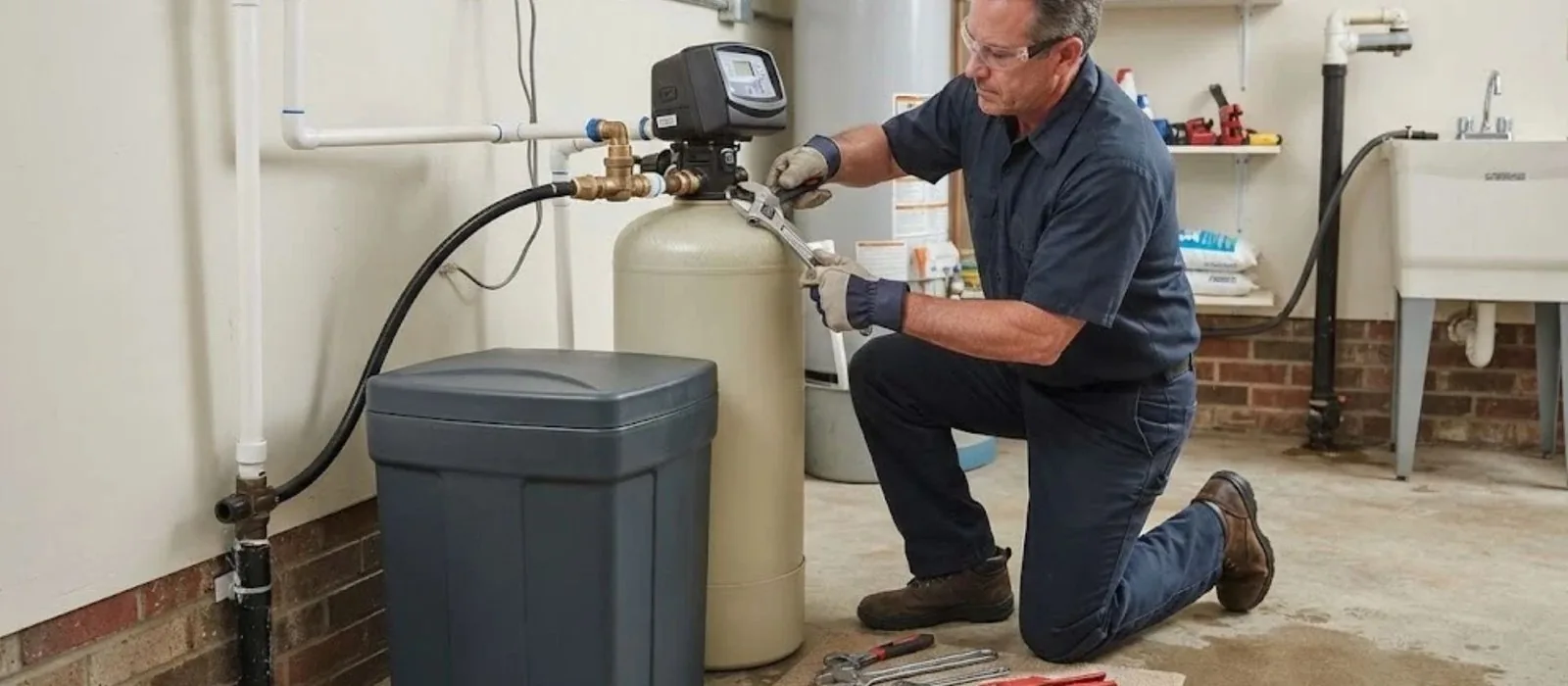
What the installation involves
.Find the main line
The unit goes on the cold main after the shutoff and before the heater, with an outdoor spigot kept on hard water if possible.
Set the bypass
A three-valve bypass lets you isolate the unit without losing water to the house.
Run the drain
The brine and rinse water must leave through a standpipe or floor drain with an air gap so wastewater cannot siphon back.
Provide power
The control valve needs a nearby outlet. Many units use a small transformer.
Program and test
Set hardness from your test, set the regeneration time, and run a manual cycle to confirm the drain works.
The state plumbing code decides details such as the air gap on the drain line and backflow protection on the supply. Whether a permit is needed depends on the job, so the building inspections division can answer for your address.
When an existing softener acts up
.Repair is a normal reason to call, and the problem is rarely the whole unit. Common faults are a worn control valve, a resin bed that has broken down after many years, an injector clogged with sediment, or a brine tank where a salt bridge has formed.
A salt bridge is a hard crust of salt that leaves a gap underneath, so the brine never forms. You may see a full tank of salt and still have hard water. Breaking the bridge and cleaning the tank is a small fix. Replacing resin or a valve head costs more, and a plumber can help you weigh that against a new unit.
Drinking-water filters under the sink and for the whole house
.A filter protects different things than a softener does. Sediment filters catch grit. Carbon filters reduce chlorine taste. Reverse osmosis units strip out many dissolved solids and are installed at one tap for drinking and cooking.
Be wary of any claim that a filter removes everything. Ask what it is certified to reduce, and test for what concerns you. Filters need cartridge changes on a schedule, and an ignored cartridge stops helping.
Salt, sodium and who should ask a doctor
.A salt-based softener raises sodium slightly, and some households use potassium instead. For most people the added amount is small, but anyone on a sodium-restricted diet, and anyone caring for an infant or a person with kidney or heart conditions, should ask a doctor. A separate drinking tap can sidestep the question.
If you plan to pair a softener with an on-demand heater, the combination matters because scale is hard on small heat exchangers. A tankless water heater benefits from soft water more than most appliances.
What shapes the cost of a softener or filter job
.Softener and filter work is planned, so you can compare options before committing. Expect the price to be stated up front.
Water treatment equipment is usually a homeowner expense and not an insurance matter. If a softener leak damages floors or drywall, that damage may be a separate claim, so photograph the area and keep the invoice for the repair.
Give the dispatcher your household size and what the water does at the tap, and the first visit can be scoped sensibly.
Who may do the work
.A softener ties into the main line, a drain and a bypass, so the install is plumbing work and belongs to licensed or registered hands. Look the installer up on the state license search before anyone touches your pipes.
Water softener and filtration questions
.Yes, by the city's own measure. Its published hardness works out to 21 grains per gallon, or roughly 360 mg/L, which sits well into hard territory. City staff name dish spots and calcium on fixtures as the telltale signs, and they note that a home unit helps most households.
Hardness can vary a little by location in the system. If you want your exact number, test your tap with a hardness kit or ask a plumber to measure it.
No. Both city plants strip iron and manganese and dose chlorine and fluoride, yet hardness passes through untouched. Softening is left to the homeowner.
Usually not. Over in Eden Prairie the city softens at its plant, leaving tap water near 5 grains, and it tells residents a home unit is generally unnecessary. If you moved from Chanhassen to Eden Prairie, check before you bring an old unit along.
Yes. Well water can carry iron, manganese or other minerals that a standard softener does not handle well. Test the water first and size the equipment to what the test shows. The city of Shorewood addresses private-well owners separately, so ask them or a licensed lab where to send a sample.
Most straightforward replacements take part of a day. A first-time install with new drain and electrical work takes longer. The plumber should walk the route from the main water line to the drain before starting so the schedule is realistic.
Ask your doctor. Traditional salt-based softeners swap hardness minerals for sodium or potassium, so the amount in the water goes up slightly. Many households keep a separate unsoftened tap or a filter at the kitchen sink for drinking.
No. A softener removes dissolved calcium and magnesium. To reduce chlorine you need a carbon filter. For lead, the filter has to be certified for it, and the better first step is to ask the city whether your service line is lead.
The 24/7 line takes calls any hour. A softener that is spraying or flooding the utility room can be shut off at its bypass valve or the main water valve in the meantime, and a plumber can follow up. Ordinary softener upgrades are scheduled for daytime.
Call the line and describe what you see. Tell the plumber your town so they can talk through the hardness that matches your water supply.