
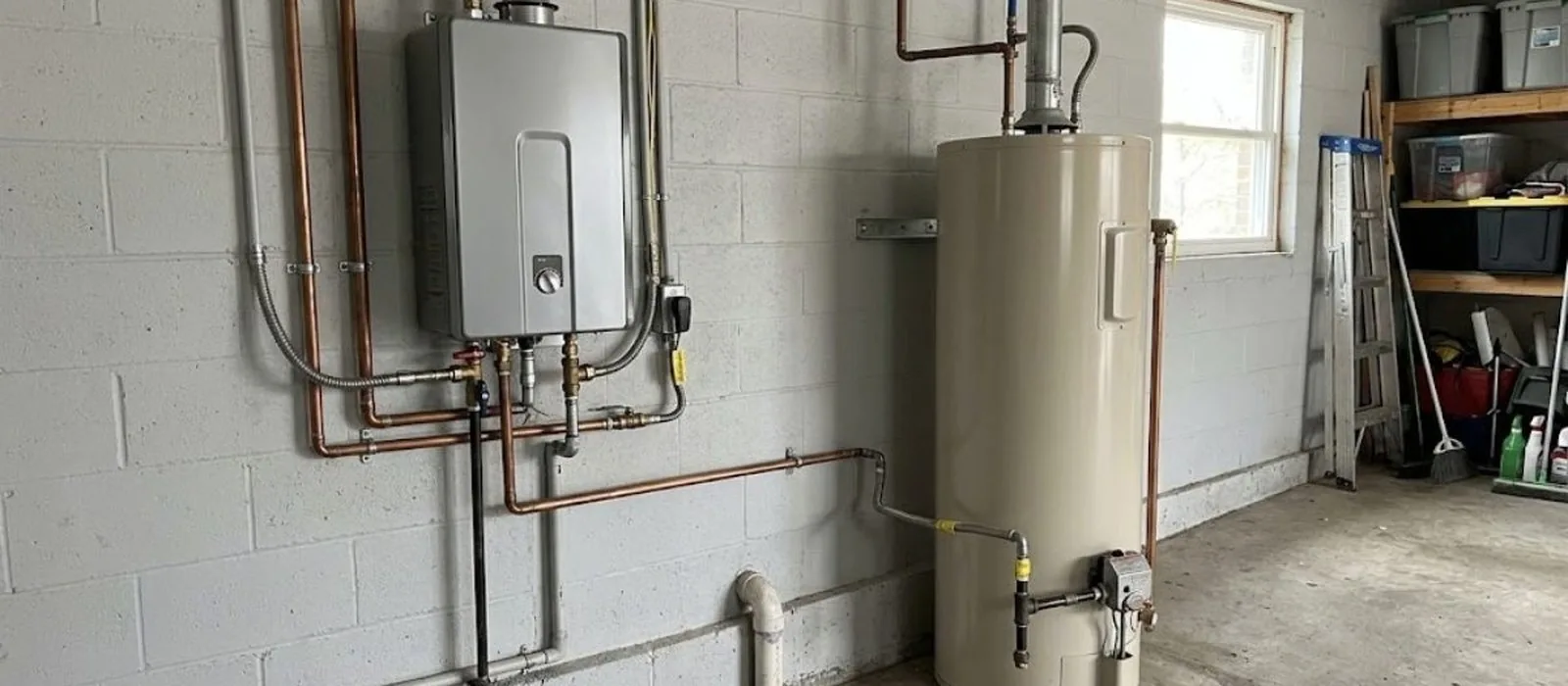
Tankless water heater basics for a Chanhassen home
.A tankless water heater in Chanhassen heats water as you use it, with no stored tank. Cold water enters, a gas burner or electric element heats it inside a compact heat exchanger, and the heated water leaves. When you close the tap, the unit shuts off. The 24/7 line covers failures, but most of what tankless owners need is planned care.
Because the water never sits in a big tank, the footprint is small and standby losses drop. The trade is that the heat exchanger has thin passages that hard water can clog. That is the main reason this page spends so much time on maintenance.
Flushing and descaling a tankless heater
.Of all the work done on a tankless unit, a flush matters most. It dissolves and rinses out the mineral scale that builds inside the heat exchanger. Many manufacturers recommend yearly in hard water areas, so check your manual for your model.
Why Chanhassen water makes this a real chore
.Chanhassen's supply is groundwater, and treatment takes out nearly all the iron and manganese without touching hardness. The city's published figure is around 21 grains per gallon. Heat drives dissolved calcium and magnesium out of the water, and they cling to the hottest surfaces.
Eden Prairie, just across the line, softens at its treatment plant and averages about 5 grains per gallon, which slows scaling for neighbors there. Identical units may end up on quite different flush schedules, depending on which city's water feeds them.
What a flush involves
.Isolate the unit
Power or gas is turned off and the service valves on the hot and cold sides are closed.
Connect the loop
Hoses link the service ports to a small pump and a bucket of vinegar or an approved descaling solution.
Circulate
The solution runs through the heat exchanger for the time the manual calls for.
Rinse and clean
Fresh water flushes out the solution. The inlet filter screen is removed and cleaned.
Restore and test
Valves are reopened, air is purged, and the unit is fired up and checked.
Units that have never been flushed may be crusted enough that a single pass does not clear it. A plumber can tell whether the unit can be restored or whether the exchanger has been damaged. If the heater is beyond saving, replacement is the next conversation.
Tell us the model and how long it has been. Call to book a flush, or use the 24/7 line if the unit has stopped working.
Error codes, lukewarm water and the cold sandwich
.Tankless heaters report their own troubles on a small display. Codes cover ignition problems, flame loss, exhaust trouble, overheating and flow sensor issues. Your manual lists what each code means, and a photo of the screen is a useful thing to have when you call.
- A code that clears after a reset and does not return may have been a one-time hiccup.
- A code that returns within days points to scale, a blocked inlet screen, a venting problem or a failing part.
- Water that swings between hot and cold during a shower can mean the flow is near the low end of what the unit can handle.
- A short burst of cold water after a pause is the cold-water sandwich, which comes from the pipe and the heat-up time, not from a fault.
A flow that is too low is sometimes the fix itself. Clogged aerators, a dirty inlet screen or partly closed valves choke the water before it reaches the heat exchanger.
Gas or electric tankless: what each asks of your house
.| Item | Gas tankless | Electric tankless |
|---|---|---|
| Fuel supply. | Larger gas line may be needed. | Heavy dedicated circuits, panel capacity. |
| Venting. | Special vent to the outdoors, often sealed. | None. |
| Condensate. | Condensing models drain acidic condensate. | None. |
| Best fit. | Houses with gas and wall space for venting. | Smaller loads or point-of-use needs. |
| Common limits. | Gas line size, vent length. | Electrical service size. |
If you are weighing a swap, our page on water heater installation covers location, clearances and permits in more detail.
Tankless units answer to the same plumbing code as tank heaters, including the Uniform Plumbing Code (UPC) provisions Minnesota carries forward. Inspectors generally look for isolation valves that make flushing possible, a relief arrangement and a condensate drain on models that make condensate. Your plumber confirms what your model needs.
Does tankless fit your household?
.| Situation | Tankless usually works if | Think twice if |
|---|---|---|
| Large household. | Peak demand fits the unit's flow rating. | Several showers and appliances run together. |
| Small household. | You want to save floor space. | You only run short taps through long cold pipes. |
| Hard water, no softener. | You will flush every year. | You skip maintenance. |
| Older home with a small gas line. | The line can be upsized. | Upsizing is impractical. |
Honest limits matter here. Tankless units do not create unlimited hot water in all conditions. Winter ground-cold incoming water lowers the flow a unit can heat to your setting, so the same model delivers fewer gallons per minute in January than in July. A plumber sizes the unit for your coldest days.
Repair, maintain or replace
.Most tankless problems fall into three buckets. Scale and clogs respond to flushing and screen cleaning. Sensors, igniters and fans are parts that can be swapped. A cracked or heavily scaled heat exchanger is a big repair and, on an older unit, may tip the balance toward a new heater.
If the heater is leaking, switch off the gas or power, close the cold supply and call. A tankless leak at a fitting is sometimes a quick repair, but a leak from inside the cabinet needs a plumber to look. Smell gas at any point, and the building should be emptied before anyone phones the gas utility or 911.
If the failure is sudden and the home is cold, water heater repair covers both tanks and on-demand units in an emergency.
When to call right away about a tankless heater
.- Water is dripping or spraying from the cabinet, and you have closed the cold supply valve and switched off the power or gas.
- Gas odor or scorch marks near the unit: step outside, ring the gas utility or 911, and bring in a plumber only afterward.
- The display shows a repeating exhaust or flame error, because a blocked vent can let combustion gases back into the room.
- Hot water has stopped in freezing weather, since pipes near an exterior wall can split before the house warms up again.
- The unit makes a loud banging or rumbling sound that gets worse each day, which often means heavy scale.
Softening the water ahead of a tankless heater
.City guidance favors a home softener for most residents. For a tankless unit, a softener or a scale-reducing filter can stretch the time between flushes and protect the exchanger. It does not replace maintenance, but it makes each service easier. Ask the plumber about softening and filtration when you book the install or the first flush.
Tankless installs and repairs sit under chapter 4714 of Minnesota Rules, the state plumbing code adapted from the 2018 UPC. A permit may be needed when a gas line or vent changes, so check with city inspectors first. A plumber's license can be confirmed in a quick search of the state's license lookup.
What drives tankless service pricing
.A flush on a well-kept unit is a different job than a rescue on a crusted one. The price is discussed before the job begins.
Routine maintenance is rarely covered by insurance, and wear-related failures are usually excluded. Sudden water damage from a leak may be covered, so photograph the scene before cleaning up.
A realistic figure needs the model, its age and the symptoms, which dispatch can collect by phone.
Tankless questions we hear in Chanhassen
.Many manufacturers recommend yearly in hard water areas, so check your manual for the exact interval. Per the city's own page, the supply sits near 21 grains, untouched by any softening step, which counts as hard.
If you run a softener on the whole house, the interval may stretch. A technician can check the heat exchanger and tell you how fast scale is building.
Some homeowners do. It takes isolation valves, a small pump, a bucket, hoses and vinegar or an approved descaler, plus careful reassembly. The risk is mistakes with the gas, power or filter. If your unit lacks service valves, a plumber should fit them first.
Each maker uses its own code list, so read the manual for your model. Common themes include ignition failure, flame loss, exhaust blockage, overheating and flow sensor problems. A code that comes back after a reset points to a real fault, often scale, a clogged inlet screen or a venting problem.
That is often called the cold-water sandwich. Hot water in the pipe cools while the unit is off, the unit starts again, and the cold slug that was in the heater arrives after the first hot water. Short draws, small flow rates and long pipe runs make it more noticeable. Some homes add a recirculation setup to reduce it.
Not in every situation. The unit heats water as it flows, so there is a ceiling on how many gallons per minute it can raise to your set temperature. Two showers and a dishwasher at once can exceed the capacity of a smaller model. Sizing matters.
Maybe. Gas tankless units often need a larger gas line than a tank and a dedicated vent made for the unit. Electric tankless units may need heavy circuits that an older panel cannot supply. A plumber checks both before recommending a model.
Yes. Flow problems, temperature swings, error codes and noisy operation are all common reasons to call. If water is leaking, shut the cold supply, switch off the power or gas and use the 24/7 line.
Book a flush, ask about error codes or start planning an install. Ask about a same-day visit, and use the overnight line if the unit has quit completely.