
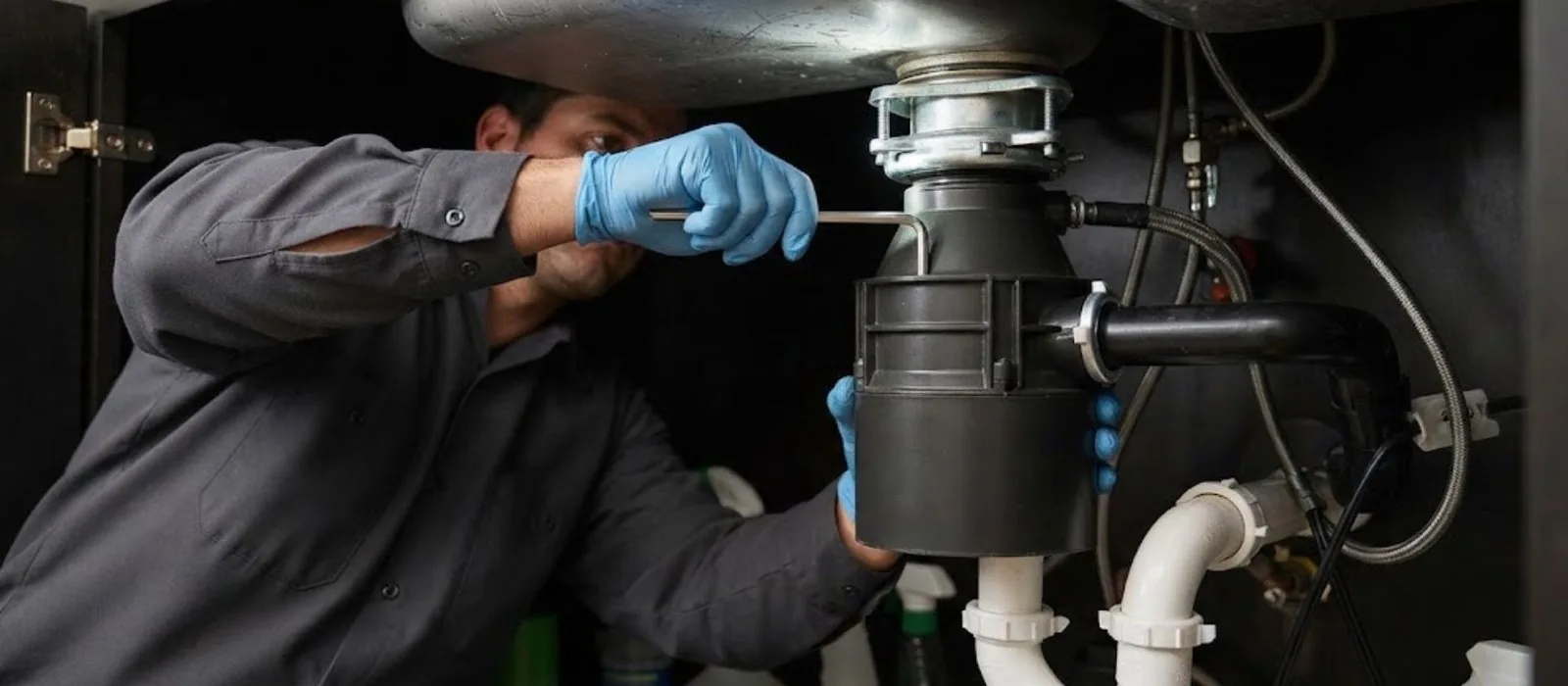
Power off before you touch anything
.Garbage disposal repair Chanhassen kitchens need most often starts with a unit that stopped or a cabinet that is wet, and the first rule is the same for both. Never put a hand into the opening, even when the switch is off. Cut power at the wall switch and at the breaker, and then look. Dispatch runs 24/7 if it is late.
A disposal runs on household current, and a leak under the sink puts water near the cord, the outlet and the switch wiring. If water is pooling and the outlet is wet, leave the breaker off and call before using the sink again. Dry cabinet floors and a dead unit can wait until morning, but a flooded one should not.
Humming, but nothing turns
.A steady hum with no grinding means the motor is getting power and something is holding the flywheel still. Bits of bone, a fruit pit, a bottle cap or a utensil can wedge between the flywheel and the shredder ring. Once power is confirmed off, many units have a hex-shaped socket in the center of the bottom. Working a hex key back and forth there frees the plate.
Wooden broom handles pushed through the top do the same job on units without that socket. Never use your fingers.
Then find the red reset button on the underside. A motor that overheated while jammed trips it. Press it once, wait a few minutes and try again. A unit that trips the reset again and again is wearing out. A motor that is silent and does nothing at all, with the reset set, points to a power problem such as a tripped GFCI outlet, a failed switch or a dead motor.
Leaks, and where they come from
.Run the disposal with a dry paper towel under it and watch where the first drop shows up. The location tells the story. A leak at the top flange, where the unit meets the sink, usually means the plumber's putty or gasket has dried out and the mounting ring needs to be reseated. Water from the side inlet points to a loose or cracked fitting on the dishwasher line.
A disposal drains through a trap, and the code has a view on that. Minnesota's plumbing rules are modeled on the Uniform Plumbing Code (UPC). Expect a look at the trap, the dishwasher drain connection and whether the line can vent, and ask your plumber what applies to your sink.
Dripping from the discharge pipe is often a loose slip nut or flattened washer.
Water from the bottom or the body seam is a different matter. Seals inside the housing have failed, and no clamp or sealant fixes that. A leaking body means replacement, and the sooner the better, since the lower bearing sits in that dampness and rust spreads quickly.
| Condition | Typical call | Reason |
|---|---|---|
| Jam, hex key frees it. | Repair. | Motor and housing are intact. |
| Leak at top flange. | Repair. | Reseat the ring with fresh putty or gasket. |
| Leak at dishwasher inlet. | Repair. | New hose clamp or fitting. |
| Leak from body or bottom. | Replace. | Internal seals cannot be serviced. |
| Reset trips repeatedly. | Replace. | Motor or windings are failing. |
| Unit around 10 years old, plus a repair. | Usually replace. | A fresh unit costs less than a repair streak. |
| Motor is dead, no hum. | Check power first. | May be a switch, outlet or breaker. |
Leave the breaker off and call the line. A licensed plumber can say whether this sounds like a quick reseat or a new unit, so you know what to expect.
Clogs that back into the other basin or dishwasher
.With a double sink, the two basins share one trap arm. When the disposal side is clear and the other basin fills with gray water as you run the disposal, the clog sits past the disposal in the drain. The same blockage can push dirty water up into the dishwasher, so a dishwasher full of standing water after a cycle belongs on this list. Running the disposal harder will not help, and chemical openers can corrode the unit's parts.
A plumber disconnects the trap and checks the disposal's discharge, then runs a cable down the line if needed. If the whole kitchen line is slow, or the laundry drains down the same stack, drain cleaning of the branch is the right fix. Grease is the usual culprit, because it cools into a coating inside the pipe and traps everything behind it.
Odors
.A smell that lingers after rinsing comes from food film on the underside of the splash guard and the grinding chamber. Ice cubes with a spoon of coarse salt, followed by a cold flush, scrub the walls. Citrus peel smells good but does little. If the odor reappears quickly, the trap or the dishwasher air gap may be holding old food, which a plumber can clear.
What can go down, and what cannot
.- Never: grease, oil and fat. They solidify downstream and form clogs far from the sink.
- Never: pasta, rice and bread in large amounts. They swell with water and become paste.
- Never: stringy vegetables such as celery, corn husks and onion skins. The fibers wrap around the grinders.
- Never: coffee grounds in bulk, eggshell piles and fruit pits.
- Fine in small amounts: soft scraps, with cold water running before, during and after.
A disposal is not a trash can. It shreds soft food into particles small enough for water to carry. Anything dense, fibrous or sticky ends up in the trap, and the pipes beyond it pay for it later.
Replacing a disposal: what the job involves
.A replacement begins by cutting power and detaching the old unit from the mounting assembly. The new flange seats in the sink with putty or a gasket, and the unit locks on with a ring that twists into place. Horsepower runs from about one-third to one, and a larger motor is quieter and handles tougher scraps. Small households often do well with a half-horsepower unit.
Wiring comes next. Some kitchens plug the disposal in, and others hardwire it through a switch. If the new unit uses a different method, a licensed electrician handles that step.
On new dishwasher setups, the knockout plug inside the disposal's inlet must be removed with a hammer and screwdriver, or the dishwasher will never drain. Forgetting it is a common error.
The discharge then reconnects to the trap, and the unit is tested with water. For a first-time install or a second basin, see plumbing installation.
Pricing a disposal repair or replacement
.Cost depends on whether the unit stays or goes. The price is spoken aloud before anything is unbolted.
Many homeowner policies treat a slowly leaking disposal differently from a sudden discharge. Note the date you first saw water, photograph the cabinet and keep the old unit if the plumber removes it.
A real number comes from a short conversation, so call the 24/7 line and describe the sound or leak.
Setting up the sink before the plumber arrives
.These four moves keep you safe and speed up the visit.
When a disposal problem turns urgent
.Most disposal faults are annoying, not dangerous. Call at once if water keeps running under the sink, if the cabinet or a nearby outlet is soaked, or if dirty water climbs in both basins. Close the angle stops under the sink for the first case. For a backup, stop running water in the kitchen and any fixture on the same line.
If sink water is also rising in the basement floor drain, the problem is in the building drain, not the disposal. Stop using water everywhere and call. A faucet that keeps running into a full sink is a separate fix covered under faucet and sink repair, and a hidden drip behind the cabinet wall can call for leak detection.
Disposal questions kitchens ask us
.Yes. Dispatch is staffed 24/7, so a flooding cabinet on a Sunday evening gets a response like any weekday call.
Switch the unit off at the breaker first, and close the angle stops if water is still reaching the sink.
No. Even with the wall switch off, fingers do not belong in the chamber. Cut the breaker, then work from the bottom with a hex key or use tongs from above.
Something is stuck between the flywheel and the shredder ring, or the motor has lost the strength to turn. Turn it off, free the jam with a hex key from below, then press the reset button.
Leaks at the flange, dishwasher inlet or discharge pipe can be fixed with new gaskets or fittings. Water from the body or bottom means the housing seals have failed, and the unit has to be replaced.
It varies with use and with what goes down. Many run for roughly 8 to 15 years. A unit near the end of that range with a new leak is usually better replaced than repaired.
The shared drain beyond the disposal is partly blocked. Water has nowhere to go, so it rises on the free side. The clog needs to be cleared from the trap or the line.
Keep the water off and the breaker down, then call. Describe the hum or the leak and a plumber can tell you whether tonight's visit is worth it.