
Stopping the water before anything else
.Faucet and sink repair Chanhassen callers need most urgently involves water that will not stop: a braided supply hose that let go, a valve handle that spins without closing, or a spout gushing after a cartridge failed. Dispatch is open 24/7. Here is how to hold the line until a plumber gets there.
Look under the sink for two small valves, one on the hot line and one on the cold. These are the angle stops. Turn each handle clockwise by hand. They are often stiff or crusty from years of sitting, so use steady pressure and never a pipe wrench, which can snap the stem.
If an angle stop will not close, or there is none, go to the main shutoff where the water line enters the house, usually in the basement or a utility room. Once it is shut, run the lowest tap in the house until the pipes empty. Watch for any water near outlets and the panel, and stay out of that area.
Dripping spouts, by faucet design
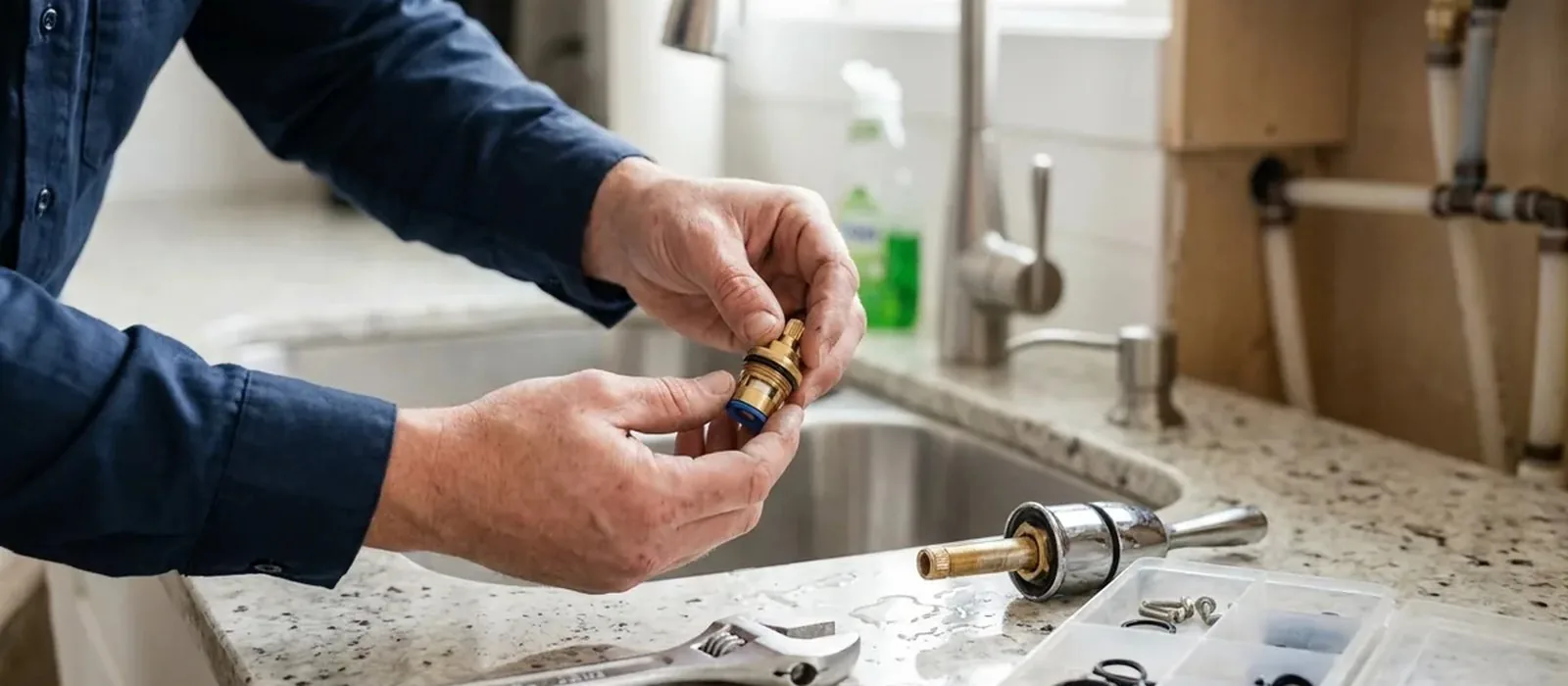
.What fails depends on how the faucet is built, so a plumber starts by identifying the type. Compression faucets, the older two-handle kind, wear a rubber washer against a seat. Cartridge faucets use a plastic or brass insert that slides to mix and shut off the flow. Ball faucets, common on single-handle kitchen models, have a slotted ball with small rubber seats and springs. Ceramic disc faucets have two polished discs that grind against each other.
Drips from a ball or cartridge faucet usually trace to worn seats and O-rings. A disc faucet drips when the cylinder cracks or the seals fill with grit. Compression washers are the easiest and cheapest fix. Whatever the design, a drip that has run long enough can pit the brass seat, and at that point the fixture is worth replacing.
| What you notice | Usual cause | Repair or replace |
|---|---|---|
| Drip from the spout when off. | Worn washer, seat, cartridge or seals. | Repair, unless the seat is pitted. |
| Leak under the handle. | Worn O-ring or loose packing nut. | Repair. |
| Water pooling at the base. | Failed base gasket or cracked body. | Replace if the body is cracked. |
| Handle spins without effect. | Stripped stem or broken cartridge. | Repair. |
| Weak or sideways stream. | Mineral buildup in the aerator. | Clean or replace aerator. |
| Drip from a shower head. | Worn valve cartridge or seat. | Repair the valve, not the head. |
| Hose bib leaks inside the wall. | Split from freezing. | Replace the bib. |
Leaks at the handle, base and braided hoses
.Water that creeps out around a handle means the packing or an O-ring has worn. Water that collects around the base of the spout points to the gasket or, on some faucets, a cracked body. Both start small. Left alone, they soak the cabinet floor, and particleboard under a sink swells and crumbles after a few months of damp.
Braided supply hoses deserve their own warning. The steel mesh hides a rubber tube, and the crimped end fittings can corrode or split with no outside sign. A hose that is a decade old can fail all at once.
Replacing the pair while the faucet is open costs little next to the cleanup after a burst. When a leak is slow and hard to find, a leak detection visit can separate a seep at the faucet from a pipe problem behind the wall.
Call the 24/7 line and say which valve is stuck. Stay on the line and the dispatcher can talk you through the main shutoff while the truck is rolling.
Seized angle stops and failed shutoff valves
.An angle stop that never gets turned can freeze in place. Mineral crust builds on the stem in hard water, and the first time it is forced, it leaks at the packing or snaps. Replacing the valve is the cure.
It is simple when the supply pipe is copper or flexible and harder when the pipe is old galvanized steel that breaks under a wrench. Installing new stops while the sink is already open is worth asking about, because it makes the next repair or an emergency far easier.
Shower and tub valves
.A shower that drips after you shut it off often needs a new cartridge, not a new head. A tub spout that dribbles while the shower runs has a worn diverter. Water that will not stop at the tub faucet at all can mean the valve is worn out inside the wall, and the cartridge may be discontinued. Pull-up diverters, lever diverters and the diverter that lives inside the spout are each fixed differently.
Some access is better than others. Good valve trim opens from the front, and a plumber may need an access panel behind the wall if the valve is older. Ask about a panel before any tile is cut. If the valve is leaking inside the wall, shut the water, and keep the shower off until a plumber has looked.
Outdoor spigots and Minnesota freezes
.Minnesota winters crack hose bibs. A hose left on a spigot traps water in the barrel, and the freeze splits it. The damage stays invisible until spring, when the first use sends water into the wall. If a bib drips from behind the siding, or the basement ceiling is wet under that wall, shut off the water to the bib and call.
A frost-free sillcock reaches through the wall so the valve seat sits in the warm side of the house, but it only works when the hose is off and the barrel can drain. Pitch matters. A bib that slopes the wrong way holds water and splits anyway. Disconnect and drain every outdoor hose by October, and replace a split bib before the weather returns, not after.
Hard water and weak flow
.Mineral-heavy city water is the quiet culprit behind many faucet complaints here. At 21 grains per gallon, per the city's own figure, it leaves chalky crust inside aerators and around cartridge seats, so a faucet can lose pressure or spit long before anything is broken.
Unscrewing the aerator and soaking it in vinegar often fixes the stream, and the same scale is why cartridges wear faster. If you see crust on fixtures, a softener or a filter is worth considering, and a plumber can explain the options.
Sink drains, traps and pop-up stoppers
.The faucet is only half of a sink. A slow bathroom sink is usually hair and soap caught on the pop-up stopper's pivot rod. A leak below the sink commonly comes from a P-trap slip nut that has loosened, or a washer that is flattened or missing. A gurgle may point to a vent issue.
Under the sink, the trap and the water supply are what the code cares about. Under the Uniform Plumbing Code (UPC) that shapes Minnesota's rules, you generally need a trap you can reach and protection against backflow where a fixture outlet could sit below rising water. The plumber checks your setup before suggesting any change.
If the sink is slow and so is the tub beside it, the blockage is further down and needs drain cleaning rather than a trap cleanout.
Jetted tubs
.Jetted tub leaks and pump noise belong in the same category as other fixture work. Access is usually through a panel near the motor. A plumber can fix the plumbing side, such as unions and jet fittings, while the motor and control board are usually an appliance repair matter.
What drives the cost of a faucet or sink call
.A drip fix and a burst-line cleanup are very different jobs. Your plumber names a price after seeing the fixture and before opening it up.
When a supply line bursts, the water damage is often handled under a different part of a homeowner's policy than the faucet itself. Photograph the failed hose or valve and keep it, since adjusters sometimes ask to see the part.
Tell the dispatcher which fixture is leaking and where, and the price discussion starts from facts.
Getting the kitchen or bath ready
.Clear access saves minutes, and minutes matter when water is running.
When to call right away: a burst line or a stuck faucet
.- Water is running and you cannot shut it off at the fixture or the main.
- The leak is near electrical outlets, a panel, a ceiling light or a sump pump cord.
- Water is coming through a ceiling or wall below the fixture.
- A frozen pipe has split and has begun to thaw.
- Hot water is spraying from a valve or hose.
Everything else, such as a slow drip or a stiff handle, can wait for a daytime appointment. Ask for the next open daytime slot.
Faucet and sink questions we hear from homeowners
.Yes. A burst supply line at midnight gets the same attention as one on a Tuesday morning, because someone answers the phone at every hour.
Shut the angle stops under the sink first if you can, and tell the dispatcher if they will not turn.
Look inside the cabinet for two small oval-handled valves on the pipes feeding the faucet, hot and cold. Turn both clockwise. If the sink has no valves, use the main.
If the faucet is under about ten years old and the body is sound, repair is usually sensible. A pitted seat, a corroded body or parts that are no longer made make replacement the better call.
A clogged aerator is the usual reason. Unscrew the tip, rinse out the grit and soak it in vinegar. If that does not help, the cartridge or supply may be restricted.
Shut the water to it from the inside valve if there is one, then have it checked. A bib that split in a freeze can leak inside the wall once it thaws.
Hard water leaves crust in aerators, cartridges and shower heads here. Over the years that cuts flow and wears out moving parts sooner.
Often yes, because many valves service from the front through the trim. Older valves or ones without replacement cartridges may need an access cut, and a plumber will tell you before starting.
Skip the guesswork and call. Someone on the line can help you isolate the problem while a crew is routed.
Where faucet repair ends
.A plumber repairs fixtures, valves, supply lines and the drain assembly. Cabinet replacement, countertop work and water-damage drying fall to other trades. If a toilet in the same bathroom needs attention, toilet repair is handled by the same visit.
Any work that adds new lines or moves fixtures is a plumbing installation job, and Minnesota expects licensed or supervised hands on it. A name typed into the state's online license search tells you in seconds whether the person is current.