
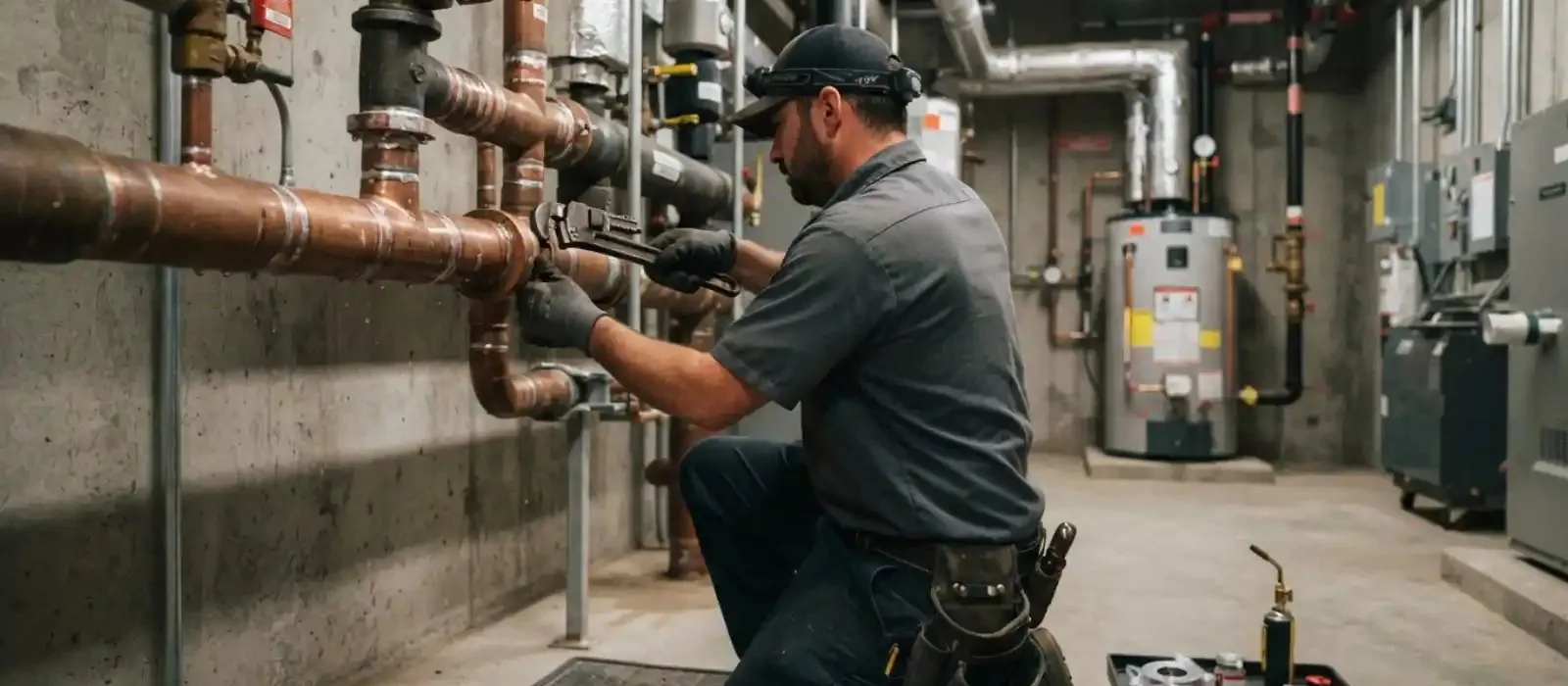
A plumbing failure after hours at a business
.Commercial plumbing in Chanhassen is urgent when water is coming in or sewage is coming up while people or inventory are at risk. Call the moment you see it, day or night, and move customers and staff away from the wet area. Shut the main or the nearest local valve, stop using affected drains and fixtures, and stay away from standing water near electrical panels or equipment.
Take photos of the source and the damage before cleanup, and write down the time you found it. A property manager or an insurer will want that record, and it helps the plumber too.
Before the plumber arrives: know where your shutoffs are
.Before we arrive
.A few minutes of prep can limit damage in a shop, restaurant, office or apartment building.
Quick triage: issue, urgency and first action
.| Issue | Urgency | First action |
|---|---|---|
| Burst or leaking supply line. | Call immediately. | Close the nearest valve or the main, then call the 24/7 line. |
| Sewage backing up from floor drains. | Call immediately. | Stop using fixtures, keep people away, call the line. |
| Clogged restroom or kitchen drain. | Same day if business is affected. | Stop flushing and pouring, call for dispatch. |
| Grease interceptor overflow. | Same day. | Close the kitchen drains and call a plumber and a hauler. |
| Water heater leaking or off. | Same day for kitchens and hotels. | Shut the heater's water supply, then call. |
| Suspected slab or hidden leak. | Soon, planned. | Check the water meter with all use off, then book a detection visit. |
| Backflow test notice. | Planned. | Ask your water supplier about the requirement and book a tester. |
The tiers are rules of thumb. A small leak that threatens electrical equipment moves up the list fast.
West 78th Street and the downtown commercial core
.Downtown Chanhassen runs along West 78th Street, where Village On The Ponds at 420 Pond Promenade and Market Street Station at 600 Market Street give the area a mix of restaurants, shops and offices. Mixed-use buildings share risks: a leak in a tenant space can reach the unit below, and a kitchen on one floor can load a drain stack that serves others.
That means you should know which fixtures share a line with your neighbors. When the plumber arrives, ask where your drain ties into the building stack and who owns the shared piece. If a backup crosses units, the answer decides who calls and who pays.
Commercial drains, grease and floor drains
.Commercial drains work harder than home drains. Restaurants send fats, oils and food solids down the line, and those cool and stick. Offices and retail space see paper waste and wipes that do not break up. Floor drains in mechanical rooms and kitchens can overflow when the downstream line is partly blocked.
For thick grease or scale, hydro jetting scrubs the pipe wall with pressurized water. Routine blockages respond to cable-based drain cleaning. A plumber should explain which fits and whether a camera check is worth doing first.
Grease traps and interceptors
.A grease trap or interceptor slows wastewater so fats can float and be removed. Pumping the contents is often done by a separate licensed hauler, so ask who your service provider is. A plumber looks at why the trap is failing, checks the inlet and outlet lines, and repairs the plumbing around it.
Floor drains and lift stations
.Some basements and below-grade spaces use a lift pit or ejector to move wastewater up to the sewer. If the pump or float fails, drains in the lower level back up. Clear the nearby floor drains and call for service when a lift pump stops cycling.
Call the dispatcher, say what is overflowing and where the shutoff is. A licensed plumber can head your way, and you can use the wait to photograph and document.
Commercial leak detection in larger buildings
.A leak in a big building is hard to see. Hidden slab leaks, leaks in wall chases, and leaks on fire or irrigation lines can run for weeks before a bill spikes or a tenant complains. Domestic water lines, fire lines and irrigation lines are separate systems, so the first job is to figure out which one is losing water.
A meter test is an easy starting point: turn off all use, watch the meter, and see if it still moves. Next, a detection visit may bring listening equipment, an infrared camera, tracer gas or a scope, chosen by pipe material and building layout. Ask which method fits your building and what the plan is for opening finished surfaces.
Backflow prevention and annual testing
.A backflow preventer stops used water, chemicals or irrigation water from running backward into the clean supply. Buildings with irrigation, boilers, fire lines or commercial equipment often have one. Testing is required by many water suppliers for certain devices, and the rules differ.
Backflow rules come from the plumbing code and from local authorities. Minnesota adopted the Uniform Plumbing Code (UPC), and under that model protection is generally required wherever contaminated water could be drawn into the drinking supply. Which devices your building needs, and whether they must be tested, is for your plumber and the city to confirm.
Ask your water supplier whether a test is required for your building and how often. A plumber or certified tester can then test the device and repair or replace worn parts. Keep the report. Property managers often need it on file.
Restrooms, flushometers and water heaters
.Commercial restrooms use flushometer valves and pressure-assisted fixtures, which behave differently from home toilets. A flush valve with a worn diaphragm can run constantly or fail to flush, and it wastes a lot of water. Replacement kits are common and quick if the plumber has the right model.
Hot water matters for kitchens, salons, gyms and hotels. A failed commercial heater can shut down a business. If a unit is old or keeps failing, a plumber can check its age and condition and tell you whether to repair or replace. Restaurants with heavy dish loads should also ask whether cleaning the main sewer line belongs on the maintenance calendar.
Scheduled maintenance beats an emergency call
.Most emergency calls in a commercial building have warning signs: slow drains, a faint sewer smell, a toilet that runs, a valve that sticks. A maintenance schedule catches them. Drain cleaning on a regular cycle, valve exercising and fixture checks cost little compared with a flooded dining room.
For property managers with several units, one standing arrangement can save time. Ask the dispatcher whether repeat service visits can be scheduled around your building's quiet hours.
Records property managers and landlords should keep
.- Dated photos and video of the source and the damage before cleanup.
- The time you discovered the problem and who shut off the water.
- A written account from the plumber of what failed and how it was fixed.
- Names and contact information of affected tenants.
- Receipts for emergency services and any temporary repairs.
- Copies of backflow test reports and inspection records.
These records support insurance claims, lease discussions and compliance checks. Start the file the moment the problem starts.
Owner or tenant: who decides what gets fixed
.Lease language settles who is responsible for a given pipe. Interior fixtures, tenant-installed equipment and shared mains are often treated differently, so one building can have three answers. The building owner and tenant decide, not the plumber.
What a plumber can do is explain what failed, what caused it, and what the repair requires. That record gives owner and tenant the same facts. If the cause is outside the tenant's space, such as a stack or a main, say so early so the owner can be called.
What a plumber does not do on a commercial site
.Sprinkler systems belong to their own licensed trade, so a plumber will not touch them. Electrical repairs belong to an electrician and structural repairs to a contractor. Natural gas smell is a separate emergency: leave the building, then call the gas utility or 911 before you call a plumber.
Tenant buildouts and repairs are plumbing work under Minnesota's adopted code, so licensed or registered workers must do them. Property managers can confirm a contractor's standing on the state labor department's online lookup. Because commercial scopes differ, the city inspections staff are the right people to ask about permits.
What affects the cost of commercial plumbing work
.Commercial jobs vary far more than residential ones. The plumber names a price once the problem has been seen, before repairs begin.
Commercial property policies treat sudden water damage, business interruption and equipment failure differently, and many exclude gradual leaks. Read your policy or ask your agent before the claim, and keep the documentation listed above.
Describe the building type, the fixture or line involved and what you have already shut off, and the likely scope takes shape.
Commercial plumbing questions from Chanhassen businesses
.Yes. Calls are taken at every hour, holidays included. A business owner or property manager can call, describe the situation and have a licensed plumber dispatched.
While you wait, shut the closest valve to the problem, keep staff and customers away from standing water near electrical equipment, and photograph the damage.
Pumping is often done by a separate licensed hauler. A plumber diagnoses why a trap or interceptor is backing up, repairs baffles, lines and fittings, and clears the pipes around it. Ask your hauler and plumber to coordinate when a trap fails.
Often yes. Detection usually starts with a meter test, then pressure checks on isolated sections, and acoustic listening or thermal imaging where needed. The method depends on the building, so ask which approach fits and why.
Many water suppliers require periodic testing of certain devices, but the rules depend on the device and the use. Ask your water supplier whether a test is required for your building before assuming either way.
That depends on your lease. Responsibility for fixtures, interior lines and shared mains varies from one lease to the next, so the building owner and tenant decide, not the plumber. A plumber can document what failed and why, which helps settle it.
No. Sprinkler work goes to a different licensed trade. A plumber can help with the domestic water supply side up to the point where the dedicated fire line starts.
Yes. Scheduled work such as drain cleaning, valve exercising, water heater checks and restroom fixture inspections reduces after-hours calls. Ask the dispatcher about setting up a repeat visit schedule.
Property managers and business owners can call any hour. Tell the dispatcher your address, the type of building and what is failing, and a licensed plumber will take it from there.