
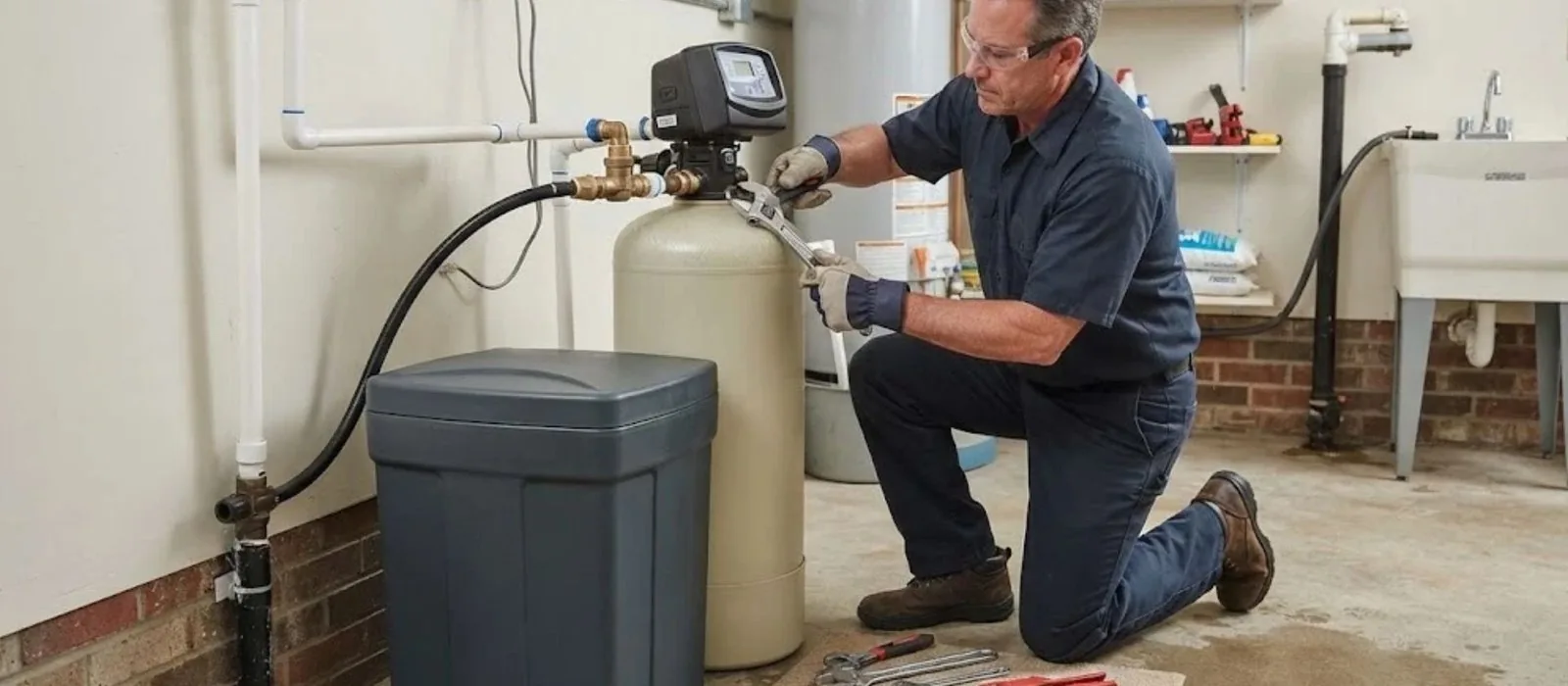
What an under-sink filter does at the kitchen tap
.An under-sink water filter treats the water at one faucet, usually a dedicated drinking tap beside the main kitchen faucet. In Chanhassen, MN it is a good fit for people who dislike a chlorine smell or want cleaner-tasting water for cooking and coffee. It is the wrong tool for scale on fixtures or spotted dishes.
The unit sits on the cold supply line, so only that tap is filtered. Showers, the dishwasher and the water heater still get untreated water. That is the first thing to settle before you spend money on any filter.
Most systems fall into three families. Sediment filters catch grit. Carbon filters reduce chlorine taste and some organic compounds. Reverse osmosis (RO) systems push water through a membrane that strips out far more dissolved material, and they usually come with their own small tank and drain connection.
Carbon block, sediment and reverse osmosis side by side
.| Type | Usually helps with | Usually does not fix | Install notes |
|---|---|---|---|
| Sediment cartridge. | Sand, rust flakes, cloudy water after line work. | Taste, chemicals, hardness. | Cold line tee, one small canister. |
| Carbon block. | Chlorine smell and taste, plus certain organic chemicals. | Hardness, most dissolved minerals. | Cold line tee, canister, often a separate tap. |
| Reverse osmosis. | Many dissolved minerals and salts, with results varying by membrane. | Scale in the rest of the house, and it wastes some water to the drain. | Tee, drain saddle, storage tank, dedicated tap hole. |
Read the certification sheet that comes with any filter you consider. Independent test standards list exactly which contaminants a model is rated to reduce. A box that only says it "improves water" tells you nothing. If the sheet does not name what it reduces, pick a different model.
Test your tap before you shop
.Buying a filter without knowing what is in your water is guesswork. A lab test of a cold tap sample, taken after the line has run for a minute, gives you a baseline. Many homeowners find the test changes what they buy.
Homes on a private well need a test even more. Well water can carry bacteria, nitrates or high iron, and no ordinary under-sink cartridge is designed to make unsafe water safe. If bacteria show up, that is a treatment question to settle with a licensed professional before you rely on the tap.
City-supplied homes can ask the utility for the latest annual water quality report. It lists what the utility adds, what it removes and the sampling results. That report is the cheapest starting point you have.
What Chanhassen's city water means for your filter choice
.Tap water here is groundwater, lifted from 11 city wells that run 441 to 530 feet down. Two city plants strip nearly all the iron and manganese before it reaches you. That means rust-colored water is not the usual complaint here, so a sediment-only filter is rarely the answer.
Dosing runs 0.6 to 0.9 ppm of chlorine, plus 0.7 ppm of fluoride that the state health department requires. Chlorine is what a carbon block targets, so a carbon filter is a sensible pick if taste is the issue. Standard carbon does not remove fluoride, and an RO membrane usually reduces it, so decide whether you want that before choosing an RO unit.
Hardness measures 21 grains per gallon (about 360 mg/L) on the city's own page, and no softening step is applied. Staff there add that a home softener helps most households. Hardness is what leaves white crust on fixtures, and an under-sink drinking filter will not touch it at the shower or the water heater, so a softener is the tool for that job.
In the 2023 report, tested at 30 customer taps and last sampled in August 2022, lead came in under 2 ppb at the 90th percentile against a 15 ppb action level. Copper was 0.85 ppm against 1.3 ppm. A 90th percentile result describes the system, not your pipes, so you can still ask the city whether your own service line is lead before deciding how much filtration you want.
Hard water, a softener and a filter can work together
.People often ask whether one device can do everything. It cannot. A softener trades hardness minerals for sodium or potassium across the entire house. A drinking filter polishes what comes out of one tap.
Where hardness is the main complaint, start with the softener. Where the chlorine taste is the main complaint, a carbon filter alone may be enough. Where both bother you, install both, and put the softener first on the line so the filter cartridges see less scale.
RO membranes in particular last longer on softened feed water, since scale is one of the things that clogs them. If you plan a softener within the next year or two, tell the installer before the RO goes in so the layout leaves room.
Call the 24/7 line. A licensed plumber can look at what is installed, find the drip and tell you whether it needs a new fitting or a different setup.
How a plumber installs an under-sink system
.Shut off and check
The cold stop valve under the sink is closed, the faucet is opened to relieve pressure, and the cabinet is cleared so the work area is dry and visible.
Add the cold line tee
A tee fitting goes on the cold supply, with a small shutoff for the filter branch so you can isolate it later.
Mount the canister
The housing is screwed to the cabinet wall with room below it to unscrew the cartridge without spilling.
Make the tap and drain connections
A drinking tap needs a hole in the sink or countertop (many sinks have a spare one). RO systems also need a drain saddle clamped to the drain line above the trap.
Flush and leak-check
New cartridges are flushed per the maker's directions, then every joint is dried and checked again after the pressure has been on for a while.
Stone and solid-surface countertops can be tricky to drill. If your sink has no spare hole, ask whether a tap that mounts through the sink deck or a counter-mounted air gap suits the layout. Do not drill granite yourself with a standard bit.
State law reserves this kind of work for licensed or registered people and licensed contractors' employees, so look your installer up on the state labor department's license search first. The drain tie-in for an RO unit is the detail that most deserves a plumber's attention.
Cartridge changes and a maintenance routine
.A filter is only as good as its last cartridge change. An old carbon cartridge can stop helping and, once saturated, may release some of what it caught. The maker's schedule is a ceiling, not a target, and heavy use shortens it.
- Sediment and carbon cartridges: follow the maker's interval and write the change date on the canister with a marker.
- RO membranes: they usually last much longer than the pre-filters, but the pre-filters protect them, so do not skip those changes.
- RO storage tank: check the air pressure on the tank once a year, since a dead tank gives a weak trickle.
- Housings and O-rings: wipe the seal and use only the lubricant the maker names, then hand-tighten.
- Drinking tap: if the flow slows suddenly, change the cartridge before you suspect the tap.
Keep the cabinet floor dry. A slow drip from a canister can sit unseen for months and soften particleboard. A small tray under the housing and a look every few weeks catches it.
Mistakes that spoil a good filter
.- Buying before testing, then discovering the real problem was hardness or something the filter was never rated for.
- Plumbing the filter onto the hot line. Heat damages cartridges, and hot lines are not meant for these systems.
- Ignoring the water heater. Scale builds up there whether or not the kitchen tap is filtered, so see the notes on installing new plumbing fixtures if you are planning other changes at the same time.
- Over-tightening plastic fittings, which crack weeks later and leak in the dark.
- Treating RO water as a replacement for medical advice about fluoride. Ask your dentist or doctor if that is a concern.
Neighbors in nearby towns face different water. Eden Prairie, for example, softens its supply at the treatment plant, so a homeowner in Eden Prairie may need a filter for taste alone. Chaska reports even harder water than Chanhassen, so households in Chaska often put the softener first.
Under-sink filter questions
.No. Standard sediment and carbon filters leave hardness alone, and the city does not soften its supply.
A softener handles hardness for the whole house. An RO unit lowers dissolved minerals at one tap, but it is not a substitute for a softener.
Follow the maker's schedule and shorten it if the water tastes off sooner or flow drops. Many pre-filter cartridges are changed every 6 to 12 months, and RO membranes last longer.
Write the install date on the housing. It takes five seconds and saves guessing.
Yes, to some degree. RO systems send part of the incoming water to the drain as they work, and the ratio depends on the model and your pressure.
If that bothers you, ask about a high-efficiency model or a plain carbon block if taste is your only concern.
Simple filters that screw onto a line can be a reasonable DIY job. Anything that adds a tee, a drain saddle or a new tap hole is easier to get wrong.
State rules reserve plumbing for licensed or registered workers, so confirm what applies before you cut into supply lines.
The city's 2023 report showed lead under 2 ppb at the 90th percentile, below the 15 ppb action level. Your own pipes are a separate question, and the city can tell you if your service line is lead.
If you want extra assurance, choose a filter whose certification sheet specifically lists lead reduction.
A plumber can mount the canister on the side wall, in an adjacent cabinet or in a basement run if the cold line is accessible. Say up front how much room you have and the installer can plan the layout.
Close the cold stop valve under the sink and call the 24/7 line. Dispatch comes out from Chanhassen to stop the leak and check the filter hookup.