
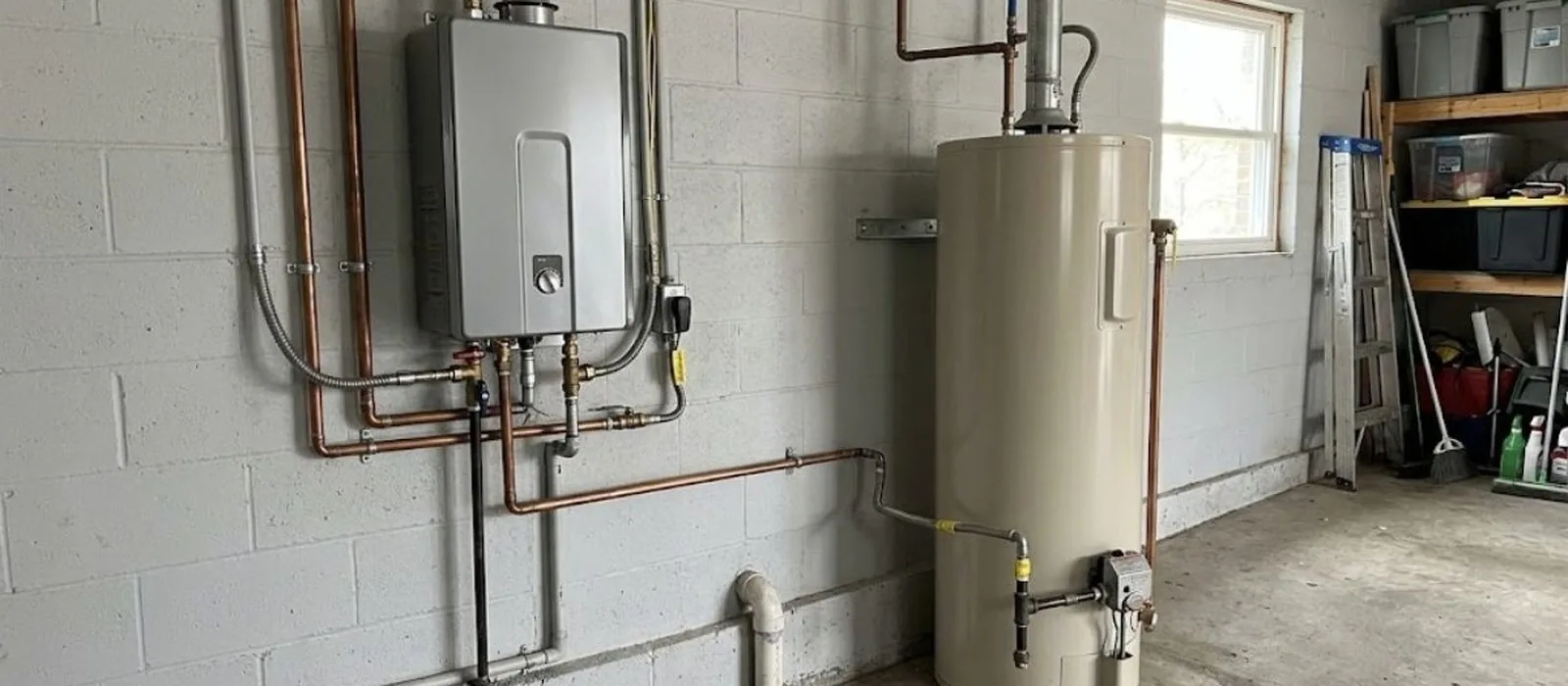
What a descaling flush does and why it can't wait forever
.A tankless heater is cleaned by circulating a mild acid, usually white vinegar or a descaler made for the job, through the heat exchanger and back out through the service valves. A small submersible pump drives the loop. Most manuals call for it about once a year, and sooner where the water is hard.
Dissolved calcium comes out of hot water and coats the narrow passages inside the exchanger. A thin crust there slows heat transfer, so the burner works harder for less hot water. Left alone it can cause overheating faults or a cracked exchanger. Follow the manual for your model, since intervals and procedure vary by maker.
Signs your unit has started to scale up
.- Hot water that takes longer to arrive or never quite reaches the temperature you set.
- Temperature that swings from warm to hot and back during a shower.
- An error code on the display, or a unit that shuts itself off mid-use.
- Rattling, popping or a higher burner pitch than the heater used to make.
- Lower flow from hot taps while the cold side looks normal.
Any one of these can point to something else, such as a clogged inlet screen or a failing sensor. Scale is the common suspect in a home with hard water, so it is the first thing to rule out.
Power and gas off
Switch off the electrical supply and close the gas valve to the unit. Let the water inside cool.
Close the water valves
Shut the cold supply and hot outlet isolation valves, then open the service ports to relieve pressure.
Hook up the pump
Connect hoses from the pump and a bucket of descaling solution to the service ports so the liquid loops through the exchanger.
Circulate
Run the pump for the time the manual calls for. Forty-five minutes is common, though your model may differ.
Rinse and restart
Drain the solution, flush with clean water, clean the inlet screen, restore valves, power and gas, and check for leaks.
Dispatch can send a licensed plumber who has done this on many models. Call the 24/7 line and describe the error code you are seeing.
Vinegar or a purpose-made descaler
.Plain white vinegar works for light to moderate scale and costs little, which is why it shows up in most how-to guides. Purpose-made descalers are formulated to dissolve heavier buildup and are safe for the metals in the exchanger. Some manufacturers specify one over the other, so check the manual.
Do not substitute strong drain or toilet bowl cleaners, bleach blends or anything your manual does not list. Mixed chemicals can attack seals and produce fumes. Rinse thoroughly afterward so no acid sits in the lines.
| Condition | Typical approach | Why |
|---|---|---|
| Soft or softened water. | Annual flush as the manual says. | Light scale, but sediment and screens still collect debris. |
| Moderately hard water. | Flush more often, check the inlet screen. | Scale builds on a faster schedule. |
| Very hard, no softener. | Flush often and consider treating the supply. | Scale can outrun even regular flushing. |
| Heater already throwing codes. | Flush first, then diagnose. | Cleaning rules out the common cause. |
Hard water in Chanhassen, Chaska and Eden Prairie
.Where you live changes how often this chore comes around. The same model can need very different care depending on which utility supplies your house.
Three water supplies, three maintenance habits
.Chanhassen's city water comes from groundwater, and the city's water page puts hardness at 21 grains per gallon. Iron and manganese come out at the plants, but softening is left to you, and the city suggests a home softener for most households. For a tankless owner that means scale forms quickly, so flushing on a tighter schedule is realistic.
Chaska to the south and southwest reports 26 grains per gallon in its own water report, harder still, and that city's report calls a softener very important. A Chaska heater is likely to scale faster than one in Chanhassen.
Eden Prairie runs a softening step at its plant, giving a tap average near 5 grains per gallon according to the city. A tankless unit there collects far less scale, so the annual flush is mostly about debris and screens. Test your own tap if you are unsure what you are getting.
Do it yourself or hire it out
.The flush itself is not difficult if you can follow a manual. The risks are in the details: closing the wrong valve, leaving the gas on, or restarting before the unit has refilled. A mistake can leak water or scorch the exchanger.
Flushing a tankless unit means working on valves that the plumbing code expects to be there. The state code draws on the Uniform Plumbing Code (UPC), where service valves and a proper relief setup are generally expected on the unit. If yours lacks service valves, ask a plumber what to add.
Have a professional handle it if the unit is a gas model with no visible service valves, if it throws a persistent error after flushing, or if you smell gas or see rust. Gas appliances should only be worked on by licensed plumbers. If you smell gas, leave the home and call the gas utility or 911 first.
A tankless water heater service visit often includes the flush, a combustion check and sensor testing in one trip. That is a better value than repeat DIY attempts on a unit that keeps faulting.
Cut down on future scale
.Flushing treats scale after it forms. The better long-term fix is to reduce the minerals reaching the heater in the first place. A properly sized softener on the cold supply makes the exchanger's life far easier, and a softener or filtration setup can be added ahead of the heater.
Even with a softener, plan on checking the inlet screen and the service valves during your yearly flush. Debris from the line, not only scale, can restrict flow.
Tankless flush questions
.The manual sets the interval, and about once a year is the usual starting point. Hard water without a softener may call for more frequent service.
If the unit starts losing temperature or throwing codes, flush it even if the date has not come up.
Most manufacturers allow white vinegar, but a few specify their own descaler. Read the manual first, and never mix vinegar with other cleaners.
Circulation is often about 45 minutes, plus time to set up, rinse and restart. Your manual gives the exact time for your model.
Sometimes. Scale is a common cause of overheating and flow faults, so flushing is a reasonable first step.
If the code returns, the problem is probably a sensor, a fan, an igniter or a venting fault, and it needs a technician.
It likely does. At 21 grains per gallon with no city softening, scale forms faster, so flush more often and consider adding a softener.
Test your own tap to see what reaches your home.
It is if you shut off power and gas, close the water valves in the right order and follow the manual. If any step is unclear, or you smell gas, stop and call a licensed plumber.
Give dispatch the error code, the age of the unit and what your water is like, and a licensed plumber can pick the next test.