
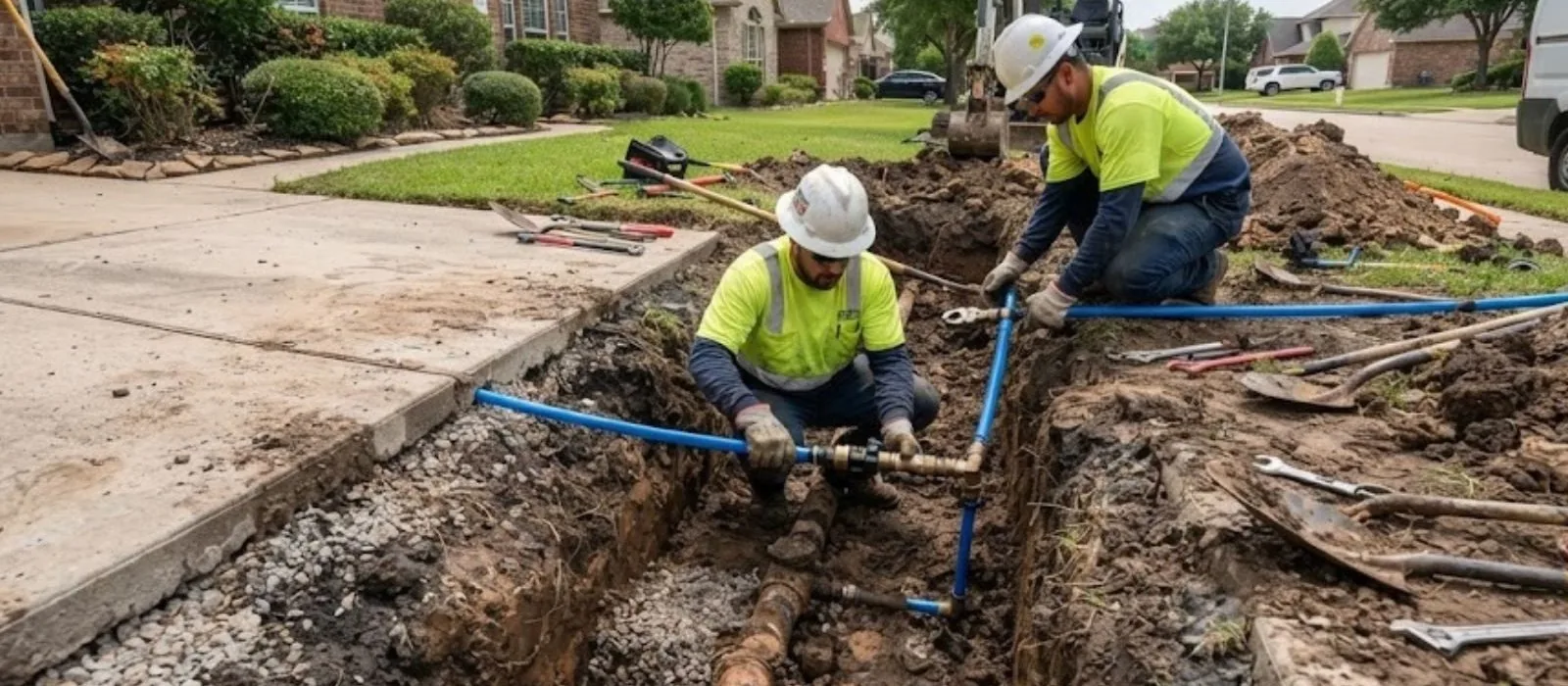
Signs your water service line has failed
.Water service line repair in Chanhassen starts when the pipe between the street and your house stops doing its job. The symptoms are rarely subtle once you know them. A wet or sunken patch of lawn with no rain, a sudden drop in pressure at every tap, a meter that runs with the house shut off, water appearing in the yard in winter, or discolored water after a pressure change.
If water is surfacing or pressure has collapsed, the line is open 24/7. Close the main shutoff inside the house if you can, avoid driving or walking over a sunken spot, and don't start digging. Crews also use leak detection methods to confirm the line is the source before any trench is opened. Buried utilities are nearby, and 811 has to mark them first.
None of these signs prove the service line is the culprit. Indoor leaks, a failed pressure regulator and a utility-side problem can look similar. A good diagnosis rules them out in order, starting with the meter and the main valve.
Where the line runs and who owns which part
.The service line is the pipe that carries water from the municipal main in the street to your home. It usually passes a curb stop, a shutoff valve near the street or property line, and then continues underground to the meter and the main valve inside. Depth depends on the frost line and the age of the installation.
In general the city maintains the main, and the homeowner owns the line from the curb stop or property line to the house. Boundaries vary, so ask the city before you assume who pays for what. A call to the city's water staff, before repair work starts, settles whether the part that failed is yours.
Lead service lines and what the city report says
.Many people ask about lead when they hear "service line replacement." Chanhassen's 2023 drinking water report lists lead at under 2 parts per billion at the 90th percentile of sampled taps, against an action level of 15, with no violations. The report's sampling was at 30 customer taps, last sampled in August 2022. Residents can ask the city whether their own service line is lead.
That matters if you are planning a repair or buying a home. If the line material is unknown, the repair is a chance to see it. Neighboring cities approach this differently. Chaska's inventory lists 1 lead line and 1,971 of unknown material, which is a good reminder to check, and the Chaska plumbing page covers that side of the county.
A lookup tool for lead service lines, maps.umn.edu/LSL, is linked from Chaska's city page, and residents there type in their address. For Chanhassen, call the city water staff and ask directly.
Repair or replace: three ways to fix the line
.The right method depends on the pipe's condition, the length of the run and what sits above it. A single clean leak in sound pipe can be spot repaired. A pipe that has failed more than once, or that is old galvanized or lead, usually needs replacement.
| Method | What it involves | Best fit | Trade-offs |
|---|---|---|---|
| Spot repair. | Dig a small pit, cut out the leak and join new pipe with a coupling. | One failure in otherwise sound pipe. | The next weak spot may fail later. |
| Trenchless replacement. | Pull or burst the old line while a new pipe follows it through a small entry pit. | Lines under driveways, walks, trees or landscaping. | Needs suitable soil and a path, and not every line qualifies. |
| Open-trench replacement. | Dig the full length and lay new pipe. | Short runs, deep damage, or lines that can't be pulled. | More restoration to the lawn, drive or walk. |
Ask which method fits your yard and why. Trenchless methods avoid cutting the lawn, but they still need access pits and aren't always possible. An honest plumber will explain what each approach leaves behind.
A licensed plumber can come out to check the meter, the shutoff and the line. Tell dispatch what you see, and ask about the plan before any digging begins.
Low water pressure: line, regulator or street?
.Low pressure has more than one cause, and not all of them are underground. Start by checking whether the problem is house-wide or limited to one fixture. A single fixture usually points to its own aerator, cartridge or stop valve. House-wide loss points to the supply side.
- A partly closed main valve or meter valve, sometimes after recent work.
- A pressure regulator that has worn out and is passing too little.
- Corroded galvanized piping that has narrowed inside.
- A leak in the service line that bleeds off flow.
- A municipal pressure change, which the city can confirm.
Screw a pressure gauge onto an outdoor hose bib and read the pressure with nothing else running. If the number is low there, work backward toward the street. If the number is fine at the main but low upstairs, the problem is in the house piping. In that case repiping may enter the conversation.
Digging safely: 811, frost and permits
.Before any digging, dial 811 and reach Gopher State One Call. Utilities will mark gas, electric, communications and other lines so a trench doesn't hit them. Allow several working days for the marks, and keep the paint and flags undisturbed.
A new service line should follow the plumbing code as well as the dig rules. Minnesota adapted the Uniform Plumbing Code (UPC) for its own use, and that model generally covers approved pipe, sound joints and a shutoff where the line enters the house. The plumber explains what applies to your trench, and permit questions go to Chanhassen's permit counter.
Minnesota frost penetrates deep, so service lines are buried below it. An exposed or shallow pipe can freeze and burst. Permit needs differ by project, so check with city inspectors before the trench opens. According to the city's permit page, a residential contractor must hold a State of Minnesota license, and the state's license lookup lets you verify a plumber.
When the line is leaking right now
.A service line that is actively leaking can undermine soil, flood a basement wall or leave you without water. Close the main valve inside the house. If water is still surfacing in the yard, the break is upstream of your valve, and the curb stop may need to be closed. That valve often takes a special key, and forcing it can break it, so leave it to the plumber or the city.
In winter, an escaped stream can freeze across a driveway or walk and become a hazard. Keep people away, and if water is flowing into the street, tell the city. A plumber can often restore service with a temporary repair when a full replacement has to wait for frozen ground. If a pipe inside the house has split instead, see burst pipe repair.
Before the crew digs
.Preparation is simple. It mainly helps the crew find the line and keep the yard in order.
After the trench: lawn, driveway and records
.A replacement leaves restoration work. Soil settles, sod needs time and a cut driveway or walk needs a patch. Ask before the work starts who handles backfill, compaction and surface repair, and take photos of the yard beforehand.
Keep a record of the new pipe material, the date and the location of any new shutoff. Photograph the open trench with the new pipe in it. It helps with future repairs and with a home sale. If the line was one that the city can inspect, ask whether an inspection is required.
What affects the price of service line work
.Costs depend heavily on what's above and around the pipe. These are the main factors.
Homeowner policies often exclude the underground line itself, though some offer an add-on endorsement. Look at your policy for service line coverage before work starts.
Ask for your own figure on the 24/7 line, and be ready with the length of the run and what sits above it.
Service line questions
.Check the meter with every fixture off. If it keeps moving and nothing inside is leaking, the buried line is a prime suspect.
Wet or sunken ground between the street and house, sudden pressure loss and water showing up in the yard in winter point the same way.
Yes. Calls are taken at night, on weekends and on holidays. Close the main valve inside the house and call.
Generally the city maintains the main, and the homeowner owns the line from the curb stop or property line to the house. Boundaries vary.
Ask the city before repair work starts so you know which part is yours.
Chanhassen's 2023 report shows lead below the action level in sampled taps, and residents can ask the city whether their own line is lead. A plumber can also identify the material when the line is exposed.
Yes. Make the 811 request through Gopher State One Call and allow a few working days, unless it is a true emergency. Ask the plumber how they handle locates.
Sometimes. Trenchless methods pull or burst a new pipe through the old path from small pits at each end.
It depends on the soil, the pipe and the route. Ask the plumber whether your line qualifies.
Causes include a leak in the service line, a failing pressure regulator, a partly closed valve, corroded piping or a utility pressure change. A gauge on a hose bib helps narrow it down.
Call the 24/7 line when the yard is wet or the pressure is gone. A licensed plumber will check whether the line is at fault, explain the repair options and name the price before any digging.