
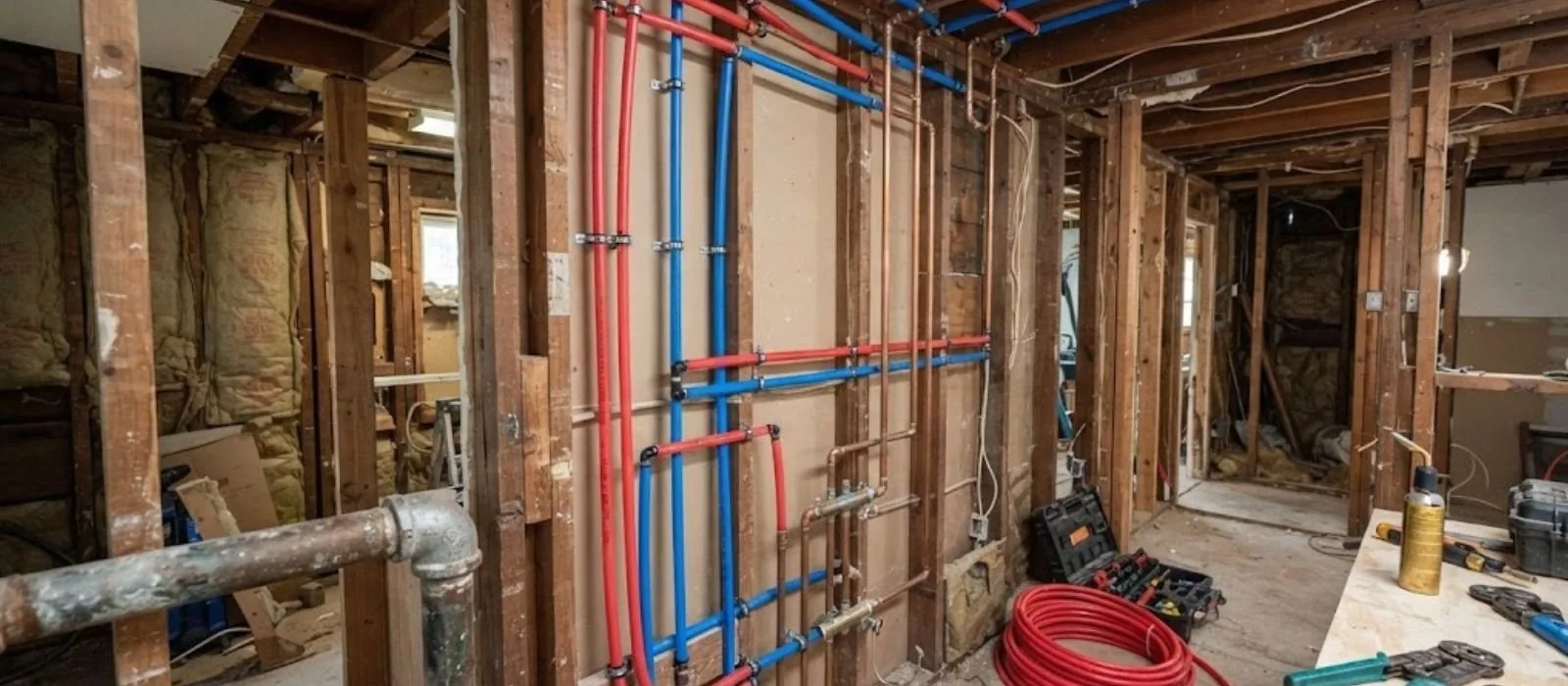
Repiping in Chanhassen: when replacing the pipes is justified
.Repiping in Chanhassen means replacing the supply pipes that carry water through a house, either all at once or in phases. It is not the first answer to a leak. A single failed joint, a frozen section or one pinhole can usually be fixed in place, as covered under burst pipe repair. Repiping becomes worth discussing when the pipes themselves are the problem.
The 24/7 line is there if a pipe fails and can't wait, but most repiping is planned work. That gives you time to compare materials, plan the access and schedule around your household. If you're not sure the pipes are the problem, a leak detection visit can show where water is really going.
Signs the supply pipes are wearing out
.Pipes rarely fail without warning. The signs build up over months or years, and they tend to appear together.
- Water pressure that has faded throughout the house, especially in older galvanized steel that narrows as rust builds inside.
- Brown or rusty water, particularly first thing in the morning or after the water has sat.
- Repeated pinhole leaks in copper, often in different places along the run.
- Stains on walls and ceilings that return after a repair.
- Visible green, white or crusty corrosion on pipes and fittings.
- Pipes that crack or leak at the joint when someone touches or moves them.
One of these signs doesn't mean the whole house needs new pipe. Several together, or a pattern that keeps coming back after repairs, makes a stronger case. A plumber can check pressure, inspect exposed runs and cut a sample from an old pipe to see how much wall remains.
Polybutylene and other known problem pipes
.Some pipe materials have a poor track record. Polybutylene, a gray or blue plastic pipe, was used in some homes built roughly between 1978 and 1995 and is a known failure risk. Many insurers and plumbers recommend replacing it, and some insurers ask about it on a policy application.
Other pipes to watch include early CPVC that has turned brittle, galvanized steel in homes of that era, and fittings from a batch with a known problem. If you're not sure what pipe you have, a plumber can usually identify it at the water heater, the main or an exposed wall.
PEX, copper or CPVC: how the materials compare
.Three materials account for nearly all residential repiping today. Each has strengths and limits, and the right choice depends on the house, the budget and the plumber's experience with it. Pipe choice is governed by Minnesota Rules chapter 4714, the state plumbing code.
Pipe sizing and materials are exactly what the plumbing code governs in a repipe. Since Minnesota's code is built around the Uniform Plumbing Code (UPC), inspectors generally check that the pipe type is approved, supports are adequate and the layout can serve every fixture. Your plumber confirms what suits your house.
| Factor | PEX | Copper | CPVC |
|---|---|---|---|
| Freeze tolerance. | Flexible and often survives freezing better than rigid pipe, though it can still split. | Rigid and more likely to split when ice forms. | Rigid and can crack, more brittle in cold. |
| Installation. | Fewer joints, long runs, quicker through walls. | Soldered joints, skilled labor, more time. | Cemented joints, simple but unforgiving. |
| Longevity. | Long service life is expected, though it is younger than copper. | A long track record when water chemistry suits it. | Varies, and age can make it brittle. |
| Fittings. | Crimp or expansion fittings at each connection. | Solder or press fittings. | Solvent-cement fittings. |
| Cost factors. | Material is usually less costly and labor is lighter. | Material is pricier and labor heavier. | Between the two, depending on the job. |
| Notes. | Needs protection from sunlight and sharp bends. | Can corrode in aggressive water. | Less common for whole-house work now. |
Ask your plumber why they recommend one material, and whether it suits your water. Per the city, local water runs about 21 grains per gallon hard, so ask how that affects fittings and the water heater, and whether a softener belongs in the plan.
Why older homes in Excelsior are different from newer ones here
.Chanhassen's housing is mostly newer. The city formed in 1967 and most homes here were built after that, so galvanized steel is less common than in older towns. That doesn't rule out supply problems, because newer pipes have their own failure modes such as pinholes, brittle fittings or known problem plastics.
Older communities tend to have more galvanized pipe. Excelsior, for example, is full of Victorian-era homes, and the Excelsior plumbing page covers that area. If your Chanhassen home was moved, added to, or built from an older structure, check what the pipe actually is before you assume.
Call the line and describe your pipes, your leaks and your timeline. A licensed plumber will talk through whether a repipe makes sense and quote the work in writing.
Whole house or one section at a time
.A whole-house repipe replaces every supply line from the main to the fixtures. It takes a few days, has the least long-term disruption and gives uniform pipe. A phased repipe tackles one area at a time, such as the worst-hit bathroom, the kitchen or the basement mains.
Phasing spreads the cost and the mess, but each phase involves its own shutoff, and the old pipe that remains can still fail. If a home has the same material throughout and has already shown several failures, doing it in one pass often makes the most sense. If failures are isolated to one area, a partial repipe may be enough.
Living through a repipe: access, shutoffs and patching
.Repiping means access. Plumbers often work through basement ceilings, crawl spaces, closets and small cut-outs in drywall. Expect some holes, with patching afterward. Ask in advance who patches and paints. Many plumbers repair drywall to a paint-ready stage and leave the finish to another trade.
Water is off during the work, sometimes for most of a day. Plan to fill containers, move laundry and showers elsewhere and keep a plan for pets and kids. Ask the plumber for a clear schedule, so you know when the water returns and when each phase will be tested.
Repiping commonly involves an inspection, so raise the permit question with city inspectors early. Any plumber doing the work should be licensed, which the state's license lookup can confirm.
What goes into a repipe price
.A repipe quote reflects the size of the house, the access and the material. These are the biggest drivers.
Homeowner insurance usually covers damage from a sudden burst, but a planned repipe for wear and age is typically a maintenance cost. If you're replacing polybutylene, ask your insurer whether it affects your policy.
Reach the 24/7 line to talk through your house. An in-person look lets a plumber put a firm price on paper.
Repiping questions
.Look for repeated leaks, rusty water, fading pressure or visible corrosion. One leak alone rarely justifies a repipe.
A plumber can inspect the pipes, test pressure and tell you whether repair or replacement makes more sense.
It depends on the size of the house, the access and the material. Many take a few days, with the water off for part of each day. Ask for a schedule up front.
Neither is better in every case. PEX is flexible, faster to install and often handles freezing better. Copper has a long track record and suits some water chemistry. Ask why a plumber recommends one over the other for your house.
Rules differ from job to job. The plumber should know the process and who handles it, and city inspectors can confirm what your house needs.
Often, if narrowed galvanized or corroded pipe was the cause. It won't fix a low-pressure municipal supply or a failing regulator, so have those checked as well. A weak buried line is a separate job: see water service line repair.
It is a known failure risk, and replacement is widely advised. Ask your insurer and a licensed plumber about your specific house.
Call the 24/7 line to book a repipe visit. A licensed plumber will look at your pipes, discuss phasing and set out the scope and price on paper.