
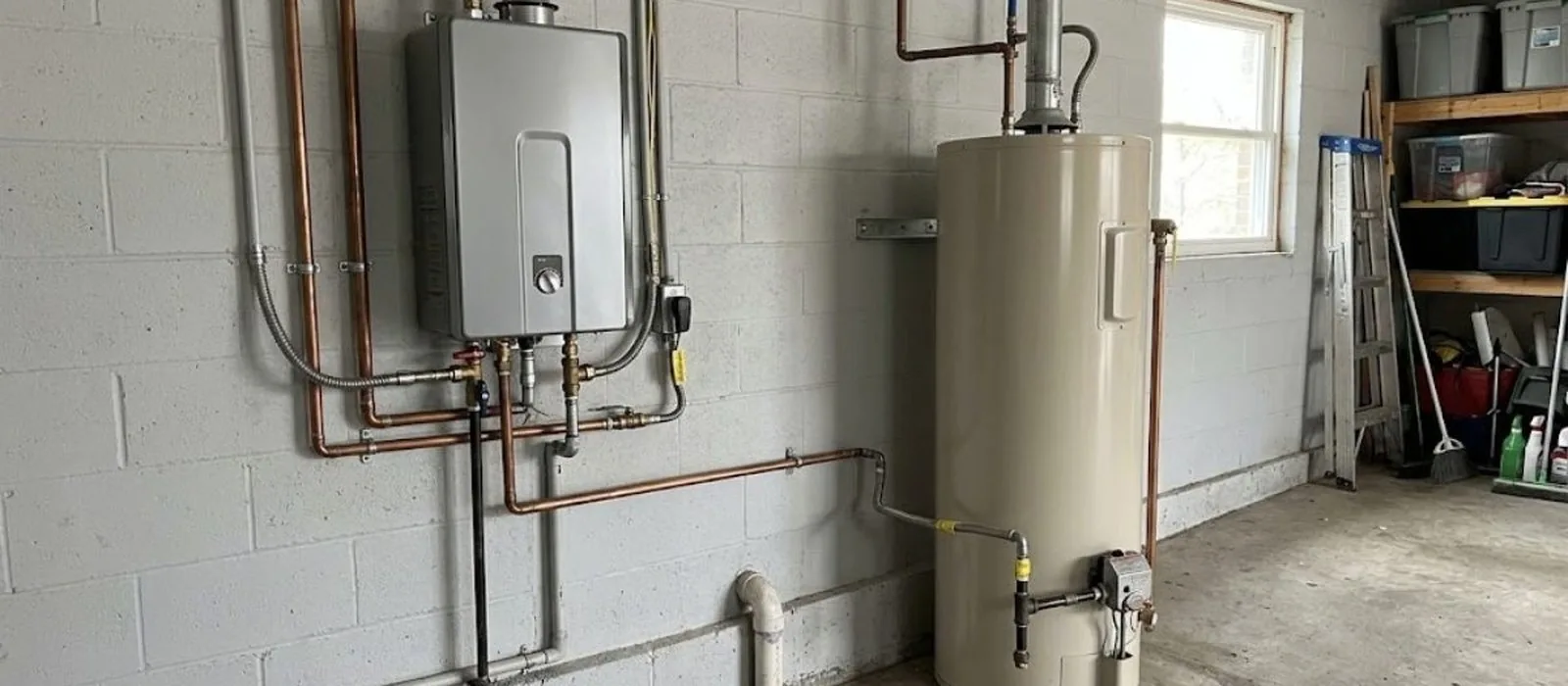
Shut it down before you go looking
.A tankless water heater leaking from the bottom is a job for your shutoffs first and your flashlight second. In Chanhassen, a heater in a basement utility room can soak drywall and flooring in an hour or two, and the unit's electronics sit low where drips land.
Turn off power or close the gas valve, then close the cold-water isolation valve under the heater. Open one hot faucet to relieve pressure. Put a towel or shallow pan under the drip and photograph the wet area for your records before you clean up.
If you smell gas or see sparks
.Step outside with everyone in the house and ring the gas utility or 911 from there. Do not flip switches or look for the leak yourself. Once the building is cleared, our 24/7 line can send a licensed plumber to the water side of the problem.
Water near a live circuit is a separate hazard. If the floor around the heater is wet, keep out of the puddle and shut off the breaker only if you can reach it while standing on a dry surface.
Where the drip usually starts
.Water runs downhill, so a leak anywhere in the unit tends to appear at the bottom. The skill is working backward to the true source. A wet bottom is a symptom, not a diagnosis.
| Where it appears | Likely cause | Typical next step |
|---|---|---|
| Small tube or neutralizer at the base. | Normal condensate from a high-efficiency unit, or a clogged neutralizer. | Check that the tube drains freely and the neutralizer media is fresh. |
| Isolation valves and unions. | Worn washers, loose nuts, a cracked valve body. | Tighten or replace the fitting after the water is off. |
| Relief valve outlet. | Pressure or temperature spike, debris on the valve seat. | Have the system pressure checked, do not plug the outlet. |
| Underside of the cabinet, nothing visible outside. | Pinhole in the heat exchanger from scale or corrosion. | Plumber inspection, often a part or unit replacement. |
| After a cold snap. | Freeze damage in the exchanger or a pipe stub. | Shut off water, call a plumber before thawing further. |
Condensate is the one drip that can be innocent
.Condensing tankless heaters pull so much heat out of the exhaust that water vapor turns to liquid inside the unit. That liquid is mildly acidic, so it is routed through a plastic tube, often to a small neutralizer cartridge, and then to a drain. A clogged tube or a full neutralizer can back that liquid up until it spills at the bottom.
Look at the tube. If it is kinked, sagging into a loop that holds water, or crusted with deposits, the leak is a drainage problem and not a plumbing failure. Clearing it is easy for some homeowners, but the unit's manual should say how to open the neutralizer, and a plumber can do it during a regular service visit.
Fittings, unions and valves that let go
.Tankless heaters move a lot of water through small connections, and each connection is a chance to weep. Heat cycles loosen unions over time. Rubber washers harden. Isolation valves that were never exercised can seep around the stem the first time someone turns them.
Shut the water off before touching any of them. A union that is only slightly loose may stop dripping with a quarter-turn, but overtightening cracks brass and plastic fast. If a valve handle is stiff or the body is stained green or white, replacement is cleaner than a repair.
Flexible connectors deserve a glance too. A braided line with a kinked or rusted end fitting can look fine from the front and drip from the back. Run a dry paper towel around each joint to find the wet one.
When the heat exchanger itself fails
.The worst bottom leak comes from inside. Scale inside a heat exchanger acts like a blanket, so parts of the metal run hotter than they should. Over time that stress can open a pinhole, and water seeps out into the cabinet and runs to the base.
This is where an honest plumber will say that repair may not be the answer. A failed exchanger is often either a costly part or a sign the heater is near the end of its life. If the unit is well into its years, a repair visit to confirm the source is still worth doing, because it tells you whether a replacement is warranted or whether a cheaper fix is hiding behind the drip.
Freeze damage in cold corners
.Tankless units hold less water than tanks, but what they hold is packed into narrow passages. In an unheated garage, a utility closet on an exterior wall or a crawl space, that water can freeze in a Minnesota January even when the heater has built-in freeze protection, because that protection needs power and gas to work.
If the leak showed up after a deep cold stretch or a power outage, tell the plumber. A cracked internal part usually does not drip until the ice melts. Do not run the heater again until it has been checked, since firing a damaged exchanger can make the damage worse.
Hard water in Chanhassen and what it does to a tankless heater
.Local tap water measures 21 grains per gallon by the city's own figure, and the plants pull out iron and manganese without softening. Water that hard leaves scale inside any appliance that heats it. For a tankless unit with narrow passages, scale builds quickly, so a yearly flush and a close look at your water are practical habits here.
Next door in Eden Prairie, the city plant brings the average down to about 5 grains per gallon. A tankless heater in Eden Prairie faces a gentler scale load than the same model in Chanhassen. If your home sits on one side of the line and a friend's on the other, do not assume their maintenance schedule fits your house.
What a licensed plumber will check, and what is outside the job
.A diagnostic visit usually starts with a dry-off, a pressure check and a controlled run so the leak can be seen forming. The plumber will look at the condensate path, the unions, the relief valve and the isolation valves, then decide whether the heat exchanger is the problem. Tankless water heater service often includes a flush and descale if the unit has never had one.
A leaking unit also has to square with the Uniform Plumbing Code (UPC) behind the Minnesota code. That model generally expects a relief valve with a safe discharge and a condensate line routed to a proper drain. Ask the plumber what applies to your model.
Some work belongs to others. Gas line modifications, vent changes and warranty parts decisions may involve the utility or the manufacturer. Ask the plumber to explain which part of the job is plumbing and which is not. Before work begins, look the plumber up in the state license search to confirm they hold a license.
Dispatch from Chanhassen also covers neighboring towns, and these checks hold whether the heater sits in Eden Prairie or Chaska. Chaska's city report lists even harder water at 26 grains per gallon, so scale-driven leaks are a familiar problem there as well.
Close the isolation valve, shut off power or gas, then call the 24/7 line. A licensed plumber can trace the drip and quote the repair before any work begins.
Cutting down the odds of the next leak
.- Flush the heater on the schedule in its manual, and sooner if your hot water temperature swings.
- Keep the condensate tube straight and the neutralizer fresh if your model has one.
- Insulate and heat the room it lives in so exposed water lines stay above freezing.
- Test the isolation valves once a year so they do not seize.
- Consider a softener if the whole house is on unsoftened city water.
Pressure matters too. Thermal expansion in a closed system can push on seals and the relief valve. Mention any recurring relief valve drip to your plumber so the cause is found and not just the symptom.
Questions about a leaking tankless heater
.Sometimes. A high-efficiency unit makes acidic condensate while it runs, and that water should travel through a small tube to a drain or a neutralizer. Wet fittings or a drip that keeps growing are not normal.
A quick test helps. Wipe the bottom dry, run hot water for a few minutes, and watch where the first bead forms. Condensate appears at the condensate line, while a supply leak shows up at a union or valve.
Not for long. A slow drip at a union can damage the cabinet, the circuit board and the floor under it. Close the isolation valves and shut off the gas or power until a licensed plumber has found the source.
Turn off the power switch or breaker for an electric unit, or close the gas shutoff on a gas unit. Then close the cold-water isolation valve below the heater. A gas smell changes the order of things: step outside and phone the gas utility or 911 before you do any more.
Opening a hot faucet afterward relieves pressure so the drip slows down.
It can. Water left in the heat exchanger and the small passages inside expands when it freezes, and the damage often shows as a leak later when the water thaws and flows. Units in unheated garages and exterior-wall closets are the usual victims.
Usually it cannot. A cracked or scale-pitted heat exchanger is normally replaced as a part or as the whole unit, depending on the age of the heater and the cost of the part. A plumber can tell you which makes sense after a look at the data plate and the damage.
It raises the odds of scale trouble, since the city reports 21 grains per gallon and applies no softening. Scale narrows the passages inside a tankless heater, which drives up temperatures and stress on seals and the heat exchanger. Regular flushing, and often a softener, slow that down.
Tell the dispatcher where the water shows up and whether you have already closed the valves. That is enough for a plumber to arrive prepared.