
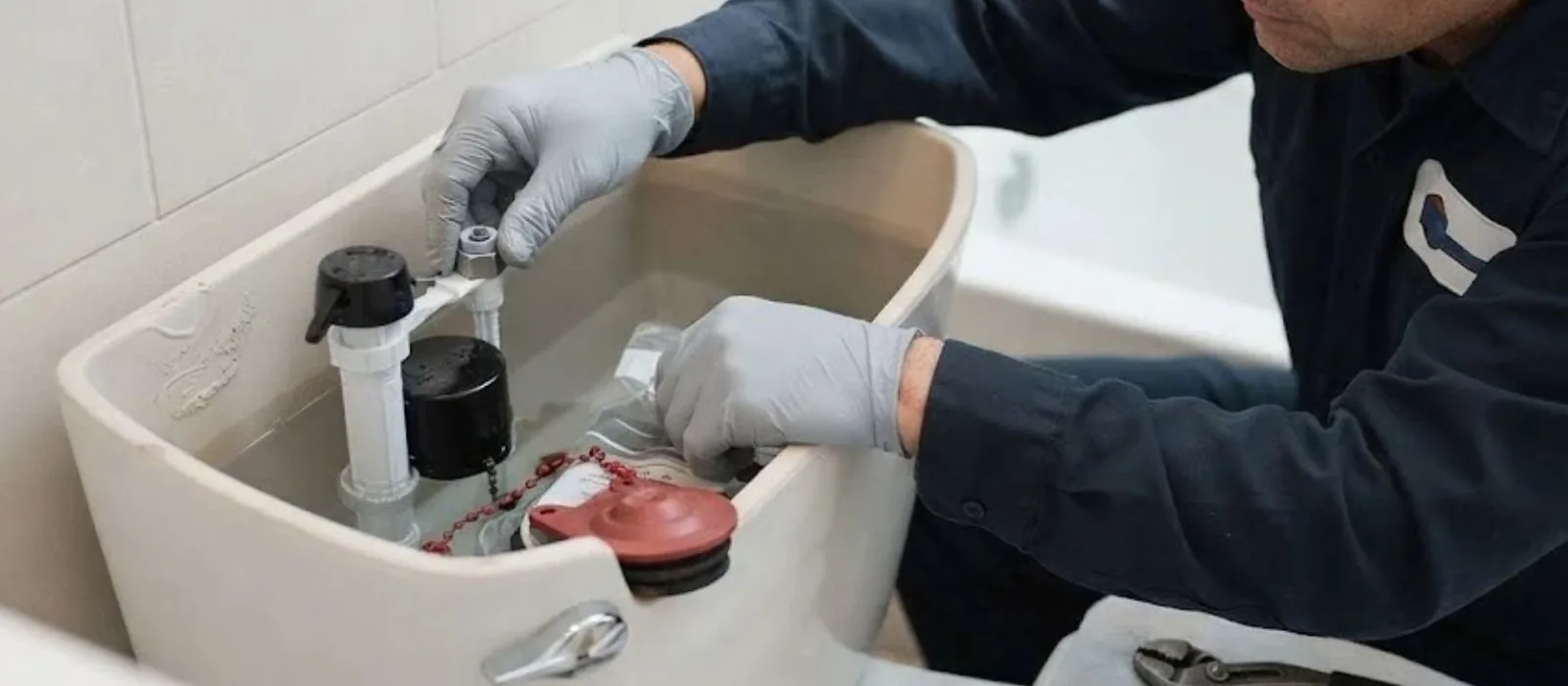
Plunge first, and plunge properly
.Most clogged toilets clear with a plunger in under five minutes. Stop flushing, lift the lid and watch the bowl. If the water is high, wait for it to drop or scoop some into a bucket so it does not spill when you push.
Seat a flange plunger so the soft rubber collar sits inside the drain opening and the cup seals around it. Push down gently first to push out trapped air, then pump with firm, steady strokes for ten or so cycles. Pull up sharply on the last one. The suction does the work, not the force.
Why the plunger type matters
.A flat cup plunger is made for sinks and tubs and will not seal in a toilet bowl. A flange plunger has an extra fold of rubber that fits the curved outlet. If yours is flat, you are fighting the tool.
Bathroom water use runs on a quiet little siphon, and a poor seal breaks it. Wet the rim of the plunger with a little water to improve the seal. Run hot tap water in the bowl only if the porcelain is not cold, since a sudden temperature jump can crack it.
When the plunger fails: the closet auger
.A closet auger, sometimes called a toilet auger, is a short cable inside a curved tube that protects the porcelain. Feed the tip into the drain, crank the handle slowly and push forward until you feel the blockage, then work it free or pull it back out.
Retrieve what you can. A toy or hairbrush is better pulled out than pushed down the line, where it may lodge deeper in the pipe. Flush once to test, and have the plunger ready in case the water rises.
| What you see | Likely cause | Next step |
|---|---|---|
| Bowl clears slowly after plunging. | Partial blockage in the trap. | More plunging, then the closet auger. |
| Water drops, then rises again on flush. | Hard object or buildup in the bend. | Auger to retrieve or break it up. |
| Tub or sink gurgles when you flush. | Blockage past the toilet. | Check other fixtures and the cleanout. |
| Several fixtures back up at once. | Main line clog. | Stop using water and call. |
| Toilet clogs every few days. | Low-flow bowl, venting or a partial line problem. | Have a plumber look it over. |
Shut the supply valve behind the bowl, then ring the 24/7 line. Dispatch can talk you through a next step or send a licensed plumber to clear it.
Things that make a clogged toilet worse
.- Pouring chemical drain openers into a stuck bowl. They sit in the water, can splash, and are hard on pipes and on the plumber who has to open the line afterward.
- Flushing repeatedly to see if it will go. Each flush adds more water to a bowl that may already be full.
- Using a wire hanger or a stiff tool on the porcelain, which scratches the glaze and can crack the bowl.
- Leaving a plunger in a cracked or loose bowl. If the toilet rocks or leaks at the base, stop and call.
- Mixing cleaners. A bleach-based cleaner added to ammonia products makes toxic fumes.
Kids' toys, wipes and flushable lies
.Most repeat clogs come from things that should never have gone down. Toys and small objects are the classic culprits when children are around. Wipes labeled flushable are not made to break up like paper and are a common cause of stubborn blockages and sewer backups.
Put a small lidded bin next to the toilet and tell guests it is for everything but paper. It costs far less than a service call.
Newer homes, one cleanout, and the clog behind the toilet
.Much of the housing here went up after the 1967 merger that formed the city, and the population kept climbing for decades. Newer houses tend to have plastic drain lines but plenty of bathrooms feeding one main line, so several fixtures backing up at once points to that line rather than a single toilet.
Find your sewer cleanout before you need it. It is usually a capped pipe in the basement near the main stack or just outside the house. Knowing where it is lets a plumber open the line quickly, and it tells you where not to dump water in an emergency.
If the toilet and the floor drain both burp or the basement shower gurgles, treat it as a main line problem and stop using water. Fixtures upstream of the blockage can flood next.
Fixture clog or main line problem?
.A single toilet that won't flush is a fixture problem. The trap bend is the narrowest part of a toilet and where most clogs form. If sinks and tubs drain fine, the plunger and auger should do the job.
A toilet that clogs again and again can point to a venting or drain slope issue, and both are code topics. Minnesota's plumbing code is adapted from the Uniform Plumbing Code (UPC), so inspectors generally check vent and slope on new work. A plumber confirms what applies to your house.
If two or more fixtures slow or back up, or if a flush sends water out of the basement floor drain, the main line is partly or fully blocked. That is a job for professional drain cleaning with a cable machine, and sometimes a camera to see why it keeps happening.
When to stop and call
.Call a plumber when the plunger and auger have both failed, when the toilet rocks or leaks at the base, or when sewage appears in a tub or floor drain. Sewage is a health hazard, so keep children and pets out and do not run the washing machine.
A plumber can pull the toilet, inspect the trap and set it again on a new wax ring, which is part of a normal toilet repair visit. The same visit can run a line if the blockage turns out to be farther down. Crews dispatched from Chanhassen also reach homes toward Victoria and across the line in Eden Prairie.
Clogged toilet questions
.A little dish soap can help lubricate a stubborn clog. Use warm water, not boiling, since a sudden temperature shift can crack porcelain.
Pour it in, wait a bit, then try the plunger again.
Close the supply valve on the wall behind the toilet. Then lift the tank lid and push the flapper down so the tank cannot refill the bowl.
It is best avoided. The liquid sits in a full bowl, can splash and may damage seals and pipes. It also makes the plumber's job more hazardous if you end up calling.
More than one fixture is slow or gurgling, or water appears in a floor drain when you flush. A blocked main line affects the lowest fixtures first.
Stop flushing. Try to retrieve it by hand with a glove or a closet auger. If it has gone down the trap, a plumber may need to pull the toilet to get it back out.
In many newer homes it is a capped pipe in the basement near the main stack, or an outdoor cap near the foundation. If you cannot find one, look along the wall where the main sewer line leaves the house.
A plumber can locate it quickly, and it is worth finding before the next emergency.
Call the 24/7 line and tell dispatch what is in the bowl, how high the water is and whether other drains are slow.