
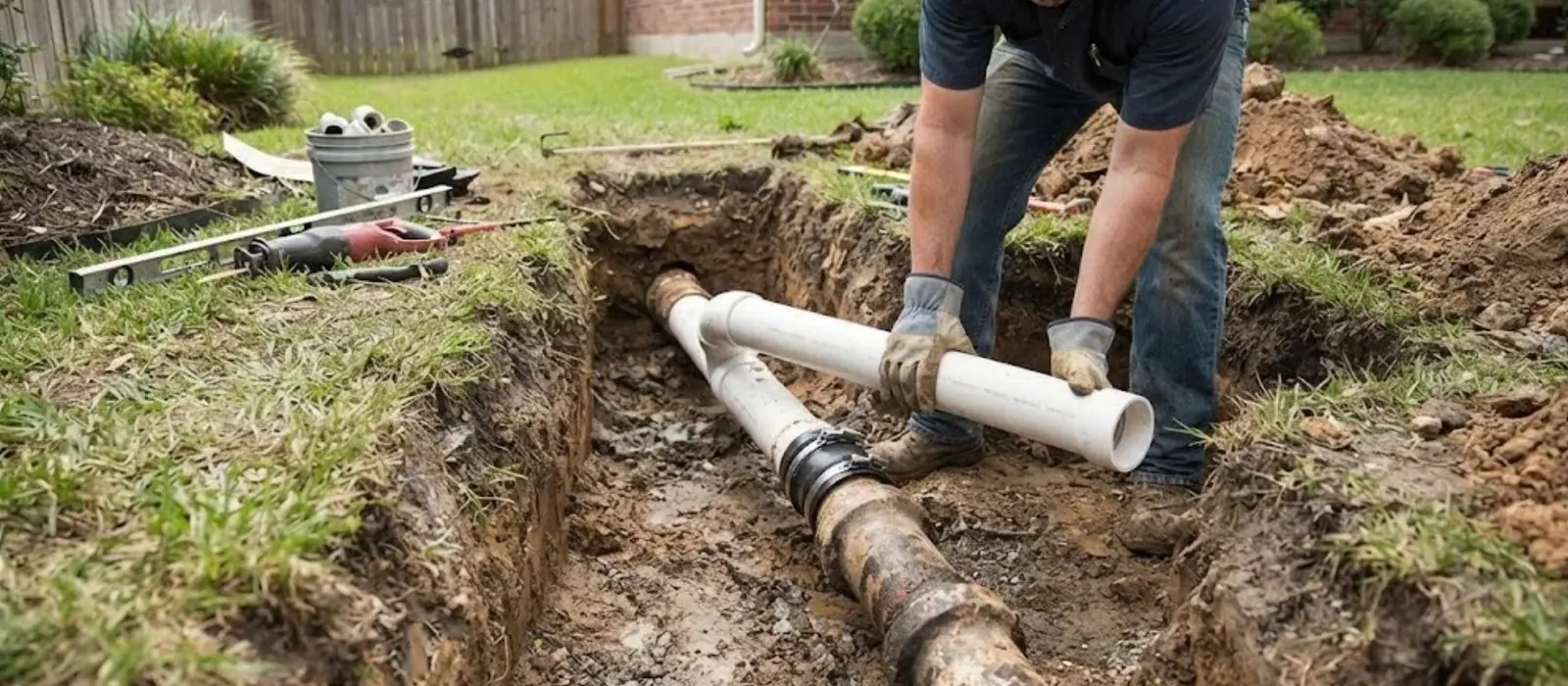
How a UV-cured liner turns an old pipe into a new one
.UV-cured pipe lining, a type of cured-in-place pipe repair, creates a new pipe inside your old sewer lateral. A resin-soaked fiberglass sleeve is pulled into the damaged line, inflated against the walls and hardened with ultraviolet light. In Chanhassen, MN it is one option for a sewer lateral with cracks, root intrusion or open joints.
The result is a smooth, jointless inner pipe. It does not replace the old pipe so much as seal it from the inside. That is why the condition of the original pipe decides whether lining works at all.
The step-by-step process
.Clean the line
Roots, scale and debris are cleared by cable or water jet so the liner can sit tight against the host pipe.
Camera survey
A video inspection confirms the pipe is intact enough, maps the bends and measures the lengths and diameters.
Insert the liner
The resin-saturated sleeve is pulled or inverted into place from a cleanout or access pit.
Inflate and cure
Air pressure presses the sleeve to the wall. A train of ultraviolet lamps travels through it, hardening the resin as it passes.
Reopen and verify
Side connections are cut open from the inside, then a final camera run checks the finished surface.
Compared with heat-cured or steam-cured liners, UV curing is often faster and the lamp train gives a controlled, visible cure. That said, the method matters less than whether the installer cleans, inspects and cures properly. Ask what standard the contractor follows and request the final video.
When lining fits and when it does not
.Lining works best when the old pipe is still round and continuous. Hairline cracks, small offsets, root entry at joints and pitted cast iron are the kinds of damage a liner can seal. It adds a thin wall inside the pipe, so the new inside diameter is slightly smaller, which usually matters little for a typical household line.
It does not suit a pipe that has collapsed, a bellied section holding standing water or a line broken into separated sections. A liner follows the shape it is placed in, so a sag stays a sag. Sharp bends and pipe that changes size can also limit the options.
| Method | Best when | Limits | Disruption |
|---|---|---|---|
| UV-cured lining. | Cracks, roots and open joints in an intact pipe. | Collapsed or badly bellied pipe, sharp offsets. | Small access points, little digging. |
| Pipe bursting. | Pipe is too damaged to line and a new pipe is wanted along the same path. | Needs entry and exit pits, nearby utilities need care. | Moderate, with pits at each end. |
| Open-trench replacement. | Collapse, bellies, wrong grade or a short run in open ground. | Landscaping and hardscape are torn up. | Highest, the full length is excavated. |
Each option has its place. The point of a camera inspection is to match the repair to the damage. A contractor who recommends one method for every house without showing you the video is not giving you the information you need.
The camera comes first
.Before any lining decision, ask for a sewer camera inspection. The recording shows the pipe material, the damage and its location. It also shows how many bends and connections are in the way.
Keep a copy of the video. It supports insurance questions, helps compare quotes and gives you a before picture. Ask for the footage afterward too, since a good lining job should look like a smooth tunnel on the final run.
Trenchless work still needs entry pits, so dial 811 first and let the locate service mark buried lines before anyone digs.
Stop using drains and call the 24/7 line. A licensed plumber can clear the line and get a camera in so you know what you are dealing with.
Old neighborhoods and newer ones: what pipe to expect
.The city took shape in 1967 when the village and township merged, and building picked up fast after the late 1960s. In most neighborhoods that makes plastic or newer vitrified laterals likelier than old cast iron or clay. Plastic pipe tends to fail by shifting or root entry at joints, which suits lining if the pipe is still intact.
Excelsior, founded in 1853 and incorporated in 1878, has many Victorian-era houses and a historic Water Street district. Houses of that age may have clay or cast iron laterals, or past repairs of mixed materials. Ask your plumber to identify the material on camera, since older pipe may be too fragile to line and is easier to judge when you can see it.
Chaska's downtown dates to brickmaking in the 1850s, with the village organized in 1871 and the city chartered in 1891. Older core blocks may have sewer lines of an age and material very different from the newer subdivisions around Highway 212. A lateral on an old lot is a candidate for a thorough camera survey before any lining quote.
Whatever your neighborhood, the pipe material is the question to settle first. Age gives a clue, but only a camera gives an answer, and the answer drives the repair choice.
Why roots and cracks keep coming back
.Tree roots look for moisture, and a hairline crack or loose joint releases it. Once a root finds the gap, it grows into a mass that catches paper and grease. Clearing the roots alone solves the clog for a while but leaves the opening.
That is why many homeowners end up with repeated service calls. Lining seals the opening so roots have nothing to enter. A liner is not a root killer though, and a large root pressing from outside can still deform a weak pipe.
If you have a recurring backup, see how sewer line repair options fit the camera findings. A clean line with a sealed liner should stop the cycle, assuming the rest of the line is sound.
Limits and honest trade-offs
.- Lining does not fix a pipe with the wrong slope. Water will still pool in a belly.
- A liner makes the pipe slightly narrower, which rarely matters but is a factor for very small-diameter or heavily scaled lines.
- Cuts for side connections and the end seals are common weak points, so ask how they are finished.
- Warranty terms differ. Read the written terms before you sign, and ask what is covered and for how long.
- Some cities have rules about work on the public portion of a lateral, so ask before any work starts.
Find out from the city's building inspections division whether a lateral repair needs a permit or inspection. Look your plumber up in the state license search, and get the price in writing.
For neighbors in nearby towns, the same logic holds. A home in Excelsior on a lot with mature trees and a century-old pipe needs a careful camera look. A home in Chaska near the older center may need the same.
Pipe lining questions
.Manufacturers and installers often cite a long service life, but results depend on the host pipe, the cure and the installation. Ask for the product's rated life in writing.
Treat any promise you cannot read on paper with caution.
No. Collapsed pipe, severe bellies and some sharp bends can rule it out. A camera survey shows what the pipe is and whether the shape allows a liner.
It seals the gaps roots use to get in, so it usually stops intrusion at those points. It cannot protect against every root force from outside, and new gaps at unlined connections can still form.
It depends on the lot, the pipe and the damage. Lining avoids landscaping and hardscape restoration, which often offsets its higher materials cost. Compare written quotes that list what is included.
Usually you need to be reachable, and you may need to limit water use during the cure. The contractor will tell you when water use is restricted, so plan around laundry and showers.
A good share of the housing stock postdates 1967, which points toward newer materials, but that is a hint, not proof. A camera inspection shows the actual pipe, and that is what should drive the repair choice.
Call the 24/7 line and ask for a camera visit. Seeing the pipe is the only way to know whether lining, bursting or digging fits.